BORNLI / product decisions
Buy the working core. Build only the missing workflow.
A subscription and a build quote are not comparable until they cover the same work. Test the awkward handoff before choosing a platform or commissioning software.
When should you buy, configure or build?
Buy or configure when an existing product handles your normal work and the exceptions you actually face. Consider a custom layer when a specific handoff, permission or integration remains unresolved. Build a whole system only when its scope and ongoing ownership justify replacing what already works.
Thoughtworks’ 2022 build-versus-buy framework separates common capabilities from differentiators and recommends evaluating smaller capabilities within a package. It is a strategy framework, not current pricing research. We checked the source on November 13, 2026. The practical test below is our own illustrative decision aid.
This decision is different from choosing AI or deterministic rules. You can buy a product that uses either, or build a small integration without using AI. First establish what work must happen and who will own it.
What must the proposed system prove?
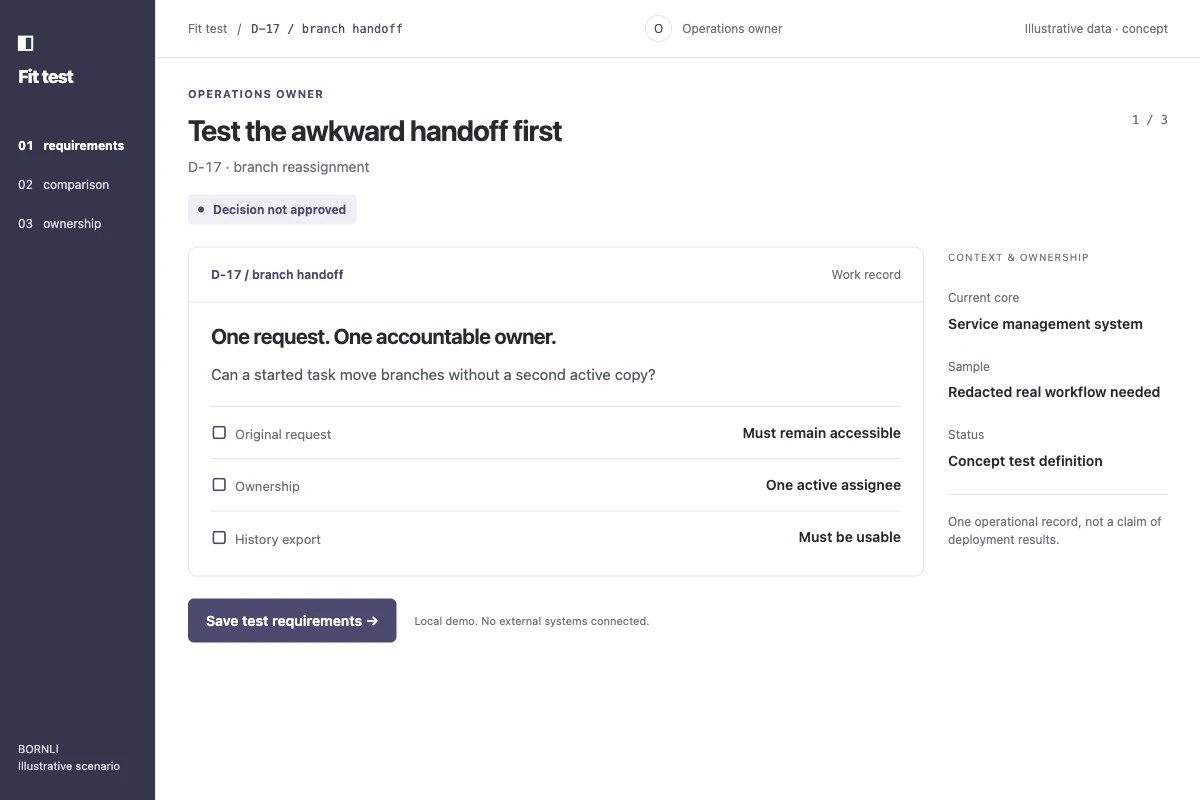
BORNLI concept demo — illustrative scenario. An operations team receives requests in a shared inbox and assigns a service task in its existing system. Normal requests already work. The difficult case is a request transferred to another branch after someone has started work: the team needs one accountable owner and an intact history.
The decision record D-17 lists three requirements: preserve the original request, transfer ownership without creating a second active task, and export the history in a usable form. Each is marked proven, failed or not tested. A vendor’s feature label is not a passing result. Ask for the actual action and saved record using a redacted sample.
How do you compare options fairly?
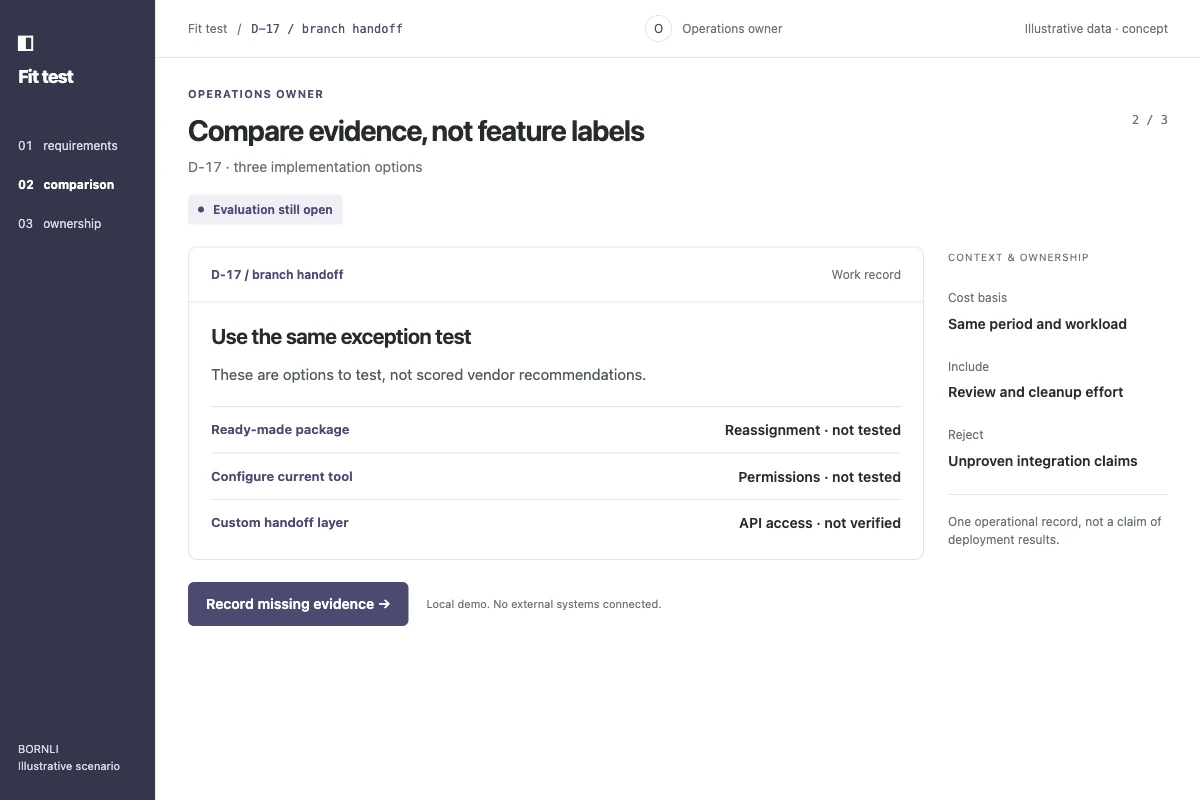
The concept compares a ready-made package, configuration of the existing tool and a small custom handoff layer. Scores are intentionally absent: there is no measured vendor evaluation. Instead, each row records evidence for one requirement and the person responsible for resolving a gap.
A connector appearing in an app directory does not prove that it supports the particular field, permission or update you need. Test a reassignment, a revoked user, a delayed reply and a record changed by another employee. If an option requires manual cleanup, include that work explicitly instead of hiding it behind “integration supported.”
What should a custom layer include?
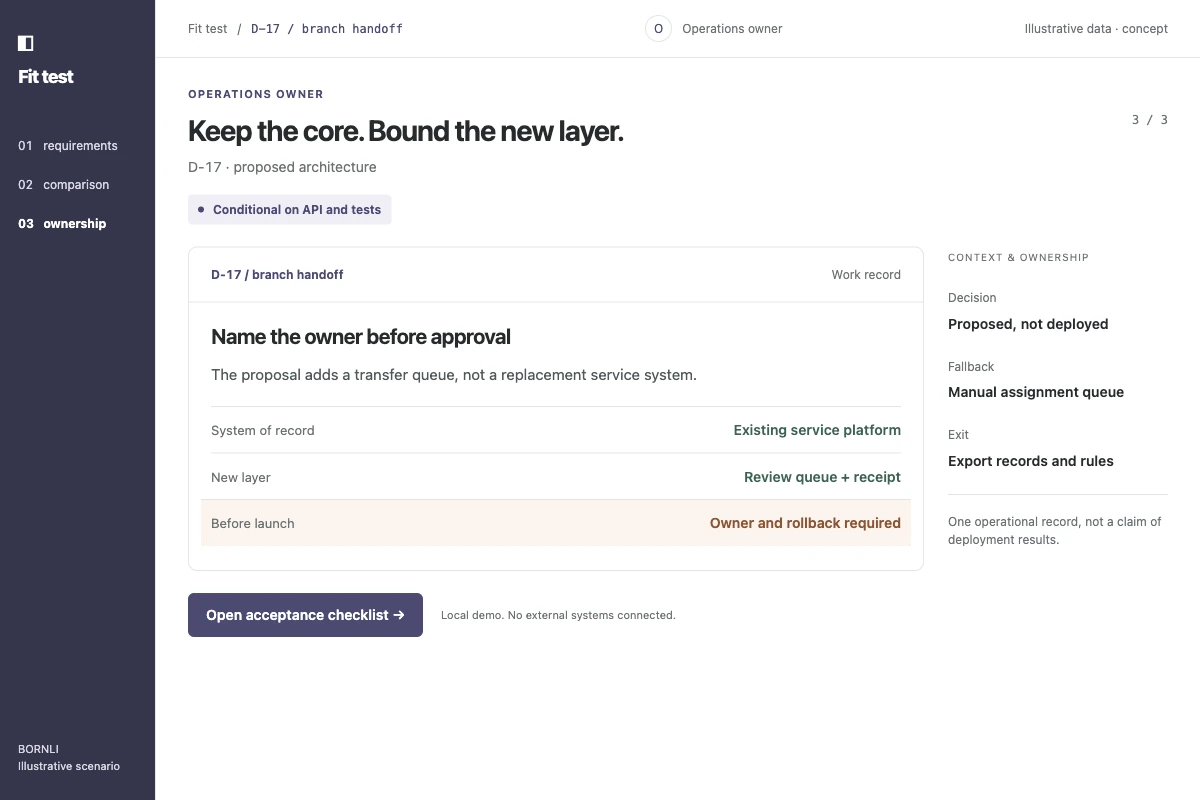
For D-17 the proposed choice is a bounded custom transfer screen on top of the existing system, conditional on API access and the exception tests passing. The core system continues to own service records; the new layer owns the review queue and transfer receipt. This is a proposed architecture, not a client implementation.
Before approval, name who monitors failures, who can authorize changes and how the team returns to manual processing. Store the business rules outside an individual employee’s chat history. Ask for exportable records, configuration documentation and an understandable handover. Rights and access are agreed in the project contract rather than inferred from a demo.
Which costs belong in the decision?
Compare the same period and workload. Include setup, migration, licenses or usage charges, integration maintenance, staff review and exit work. A useful worksheet is: total cost = setup + recurring platform and usage + internal operating effort + expected change and exit work. Use your own volumes and rates; this article supplies no universal project price or savings estimate.
- If the existing tool passes the important tests, configure it before building another interface.
- If one handoff fails but the core works, estimate that bounded layer.
- If ownership or policy is unclear, resolve it before commissioning automation.
- If the work is rare and cleanup dominates, a clearer manual queue may be enough.
Bring one real workflow, the tools you already pay for and one exception that currently needs a person. We can help map the gap and scope the next step. The pilot guide turns that gap into acceptance cases; the maintenance guide covers responsibility after launch. Neither a polished demo nor a completed build is evidence of business value until the actual workflow is measured.
Map the workflow before building it.
Tell us what your team handles manually, which tools you use, and where the process gets stuck. Start by email.
Discuss your workflow ↗