BORNLI / product decisions
A pilot you can accept—or stop
Before choosing a model, agree on one operation, its owner and what a failed result looks like. A polished demo is not an acceptance test.
What belongs in the first pilot?
An AI workflow pilot should test one bounded operation against agreed examples and a real destination. Define what enters, what may change, who approves it and what evidence proves completion. If rules and a form already solve the problem, a language model may add no value.
Anthropic’s evaluation guidance distinguishes test tasks, repeated trials and the final state of the environment. We apply that distinction below: a message saying “done” does not prove the destination was updated. This is our pilot design, not a reported Anthropic customer result.
Can the team draw a clear boundary?
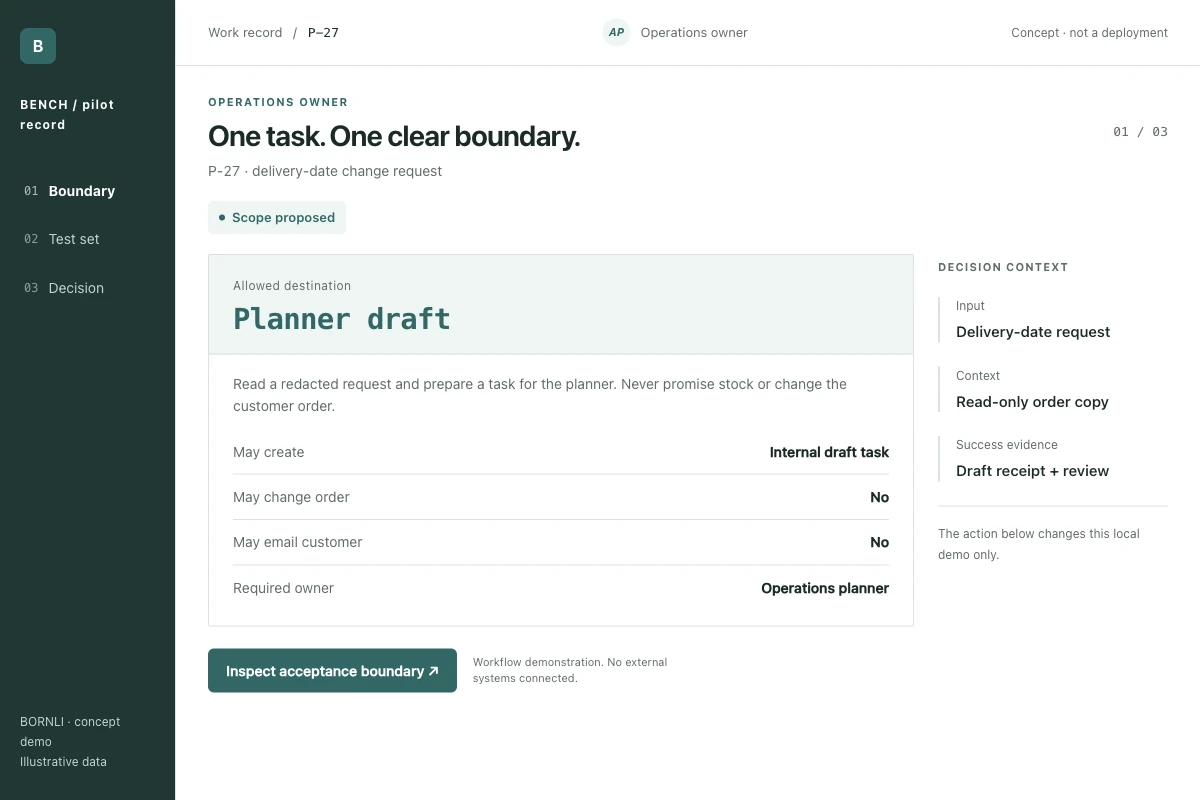
BORNLI illustrative scenario. A distributor wants a draft task for a customer-requested delivery-date change. Pilot P-27 may extract a requested date and attach its source to a planner’s queue. It may not promise stock, change an order or email a customer. All records are synthetic; no ERP or customer inbox is connected.
The operations manager owns acceptance. A planner handles ambiguous dates, missing order references and conflicting requests. The pilot uses a redacted historical sample and a read-only copy of order context; production writes remain outside this first step.
Which examples could disprove the demo?
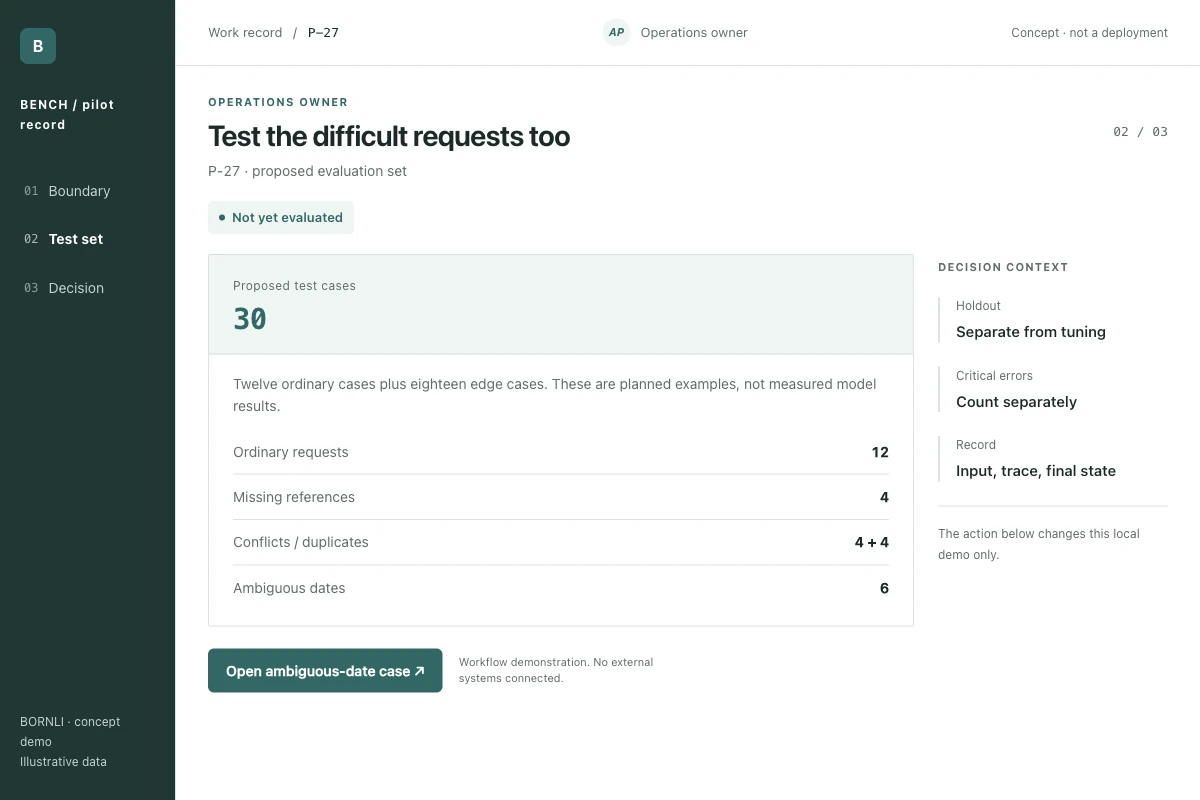
Proposed test set: 12 ordinary requests, 4 missing references, 4 conflicting messages, 4 duplicates and 6 ambiguous dates—30 examples, not a performance sample. Keep a separate holdout set before tuning. Agree an expected action and source span for each example; document disagreements between reviewers.
Repeat selected cases because outputs can vary. Check extraction and workflow separately: a correct date attached to the wrong order is a failure. “Needs human review” can be correct for an ambiguous request; inventing an exact date is not.
What does an acceptance decision record?
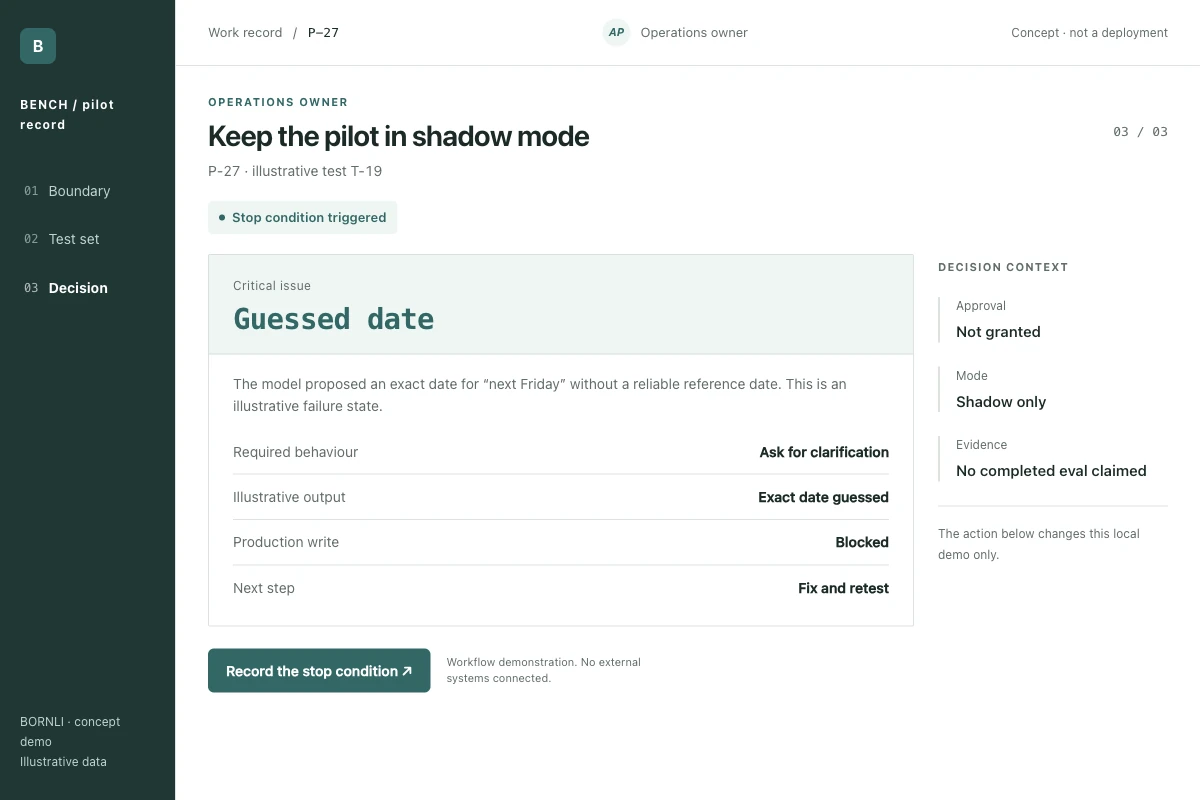
The concept shows test T-19: “next Friday” without a reliable reference date. The output proposed an exact date, so the reviewer records a critical failure and keeps P-27 in shadow mode. This is one illustrative test state, not the result of a completed model evaluation.
Do not average a wrong-order write into an attractive overall score. Agree critical failures in advance. A release decision needs a fixed version, tested integrations, a rollback path, an owner and unresolved issues. “Continue testing” is a valid outcome.
What would make the pilot worthwhile?
Compare similar request types and count reviewer time, corrections, missed exceptions and duplicate handoffs. Include human review, integration upkeep and model usage in the cost. The sample above does not establish an error rate or savings.
Bring a redacted input, the current manual steps and one example that should be refused or escalated. We can scope a first pilot over email. For concrete workflows, see inquiry routing or invoice exception review. This guide defines acceptance, rather than another generic inbox automation.
Map the workflow before building it.
Tell us what your team handles manually, which tools you use, and where the process gets stuck. Start by email.
Discuss your workflow ↗