BORNLI / product decisions
Use rules for policy. Use AI where the input needs interpretation.
Before commissioning an AI agent, separate the uncertain reading task from the business rules that must produce a predictable answer.
When does a workflow need AI instead of rules?
Use rule-based automation when the inputs are structured and the decision can be written as an explicit condition. Consider AI when a person must interpret free-form messages or documents before those conditions can be evaluated. Many useful workflows combine both: AI proposes a label or extracted field, deterministic checks validate it, and a person handles consequential exceptions.
For example, Zapier documents filters and paths for conditional logic with typed values such as text, numbers, dates and booleans. That is a product-specific example of rules, checked November 12, 2026. It is not evidence that a text filter understands a customer’s intent or that every process requires an LLM.
This guide helps an operations owner choose an implementation approach before buying custom development. It does not rank providers or promise a universal accuracy level. Bring one real operation and identify which facts are known, which are inferred and which action needs permission.
Which decisions should remain explicit?
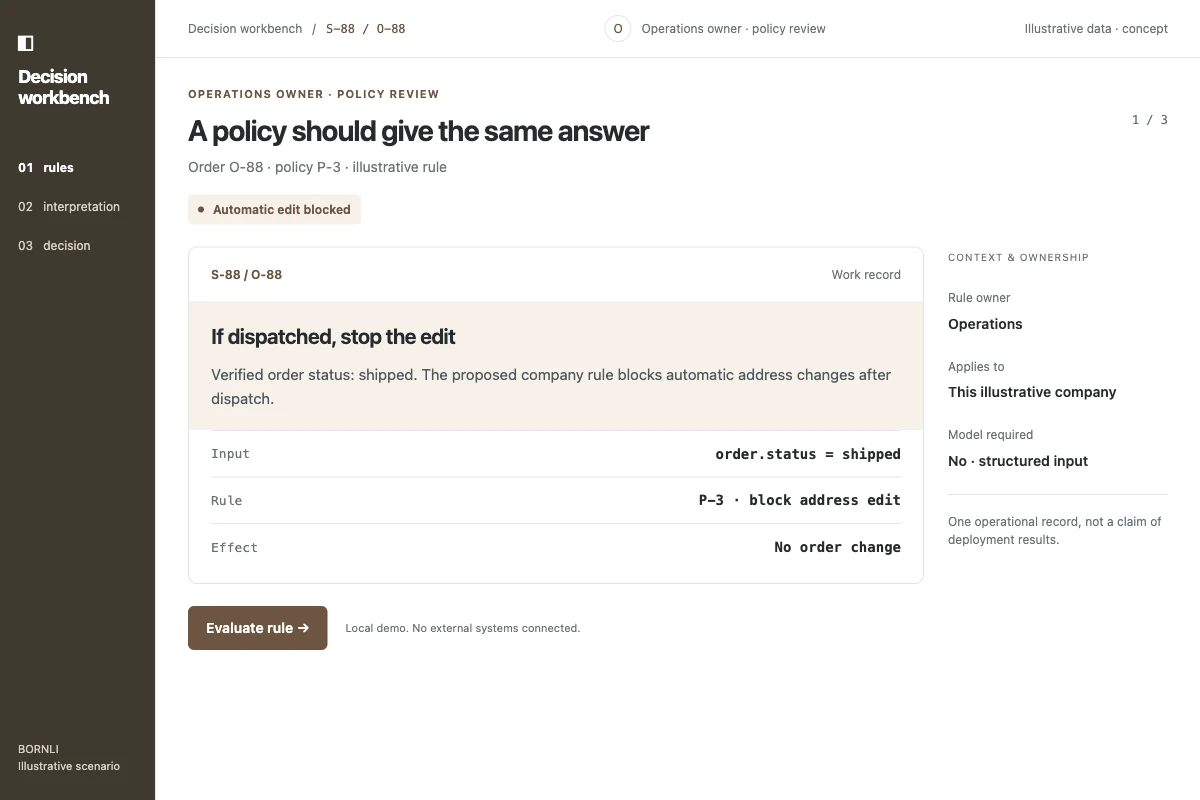
BORNLI illustrative scenario. A support request S-88 refers to order O-88. The customer asks, “Can I change the delivery address? If it is already shipped, tell me what I can do.” The order system says the order has shipped. In this proposed workflow, a company rule blocks automatic address changes after dispatch.
The rule uses the verified order status, not a guess from the message. The policy version and source are visible. A simple structured form asking for an address change could reach this decision without AI. Adding a model would not improve the authority of the order status or grant a permission the integration lacks.
Where does interpretation add value?
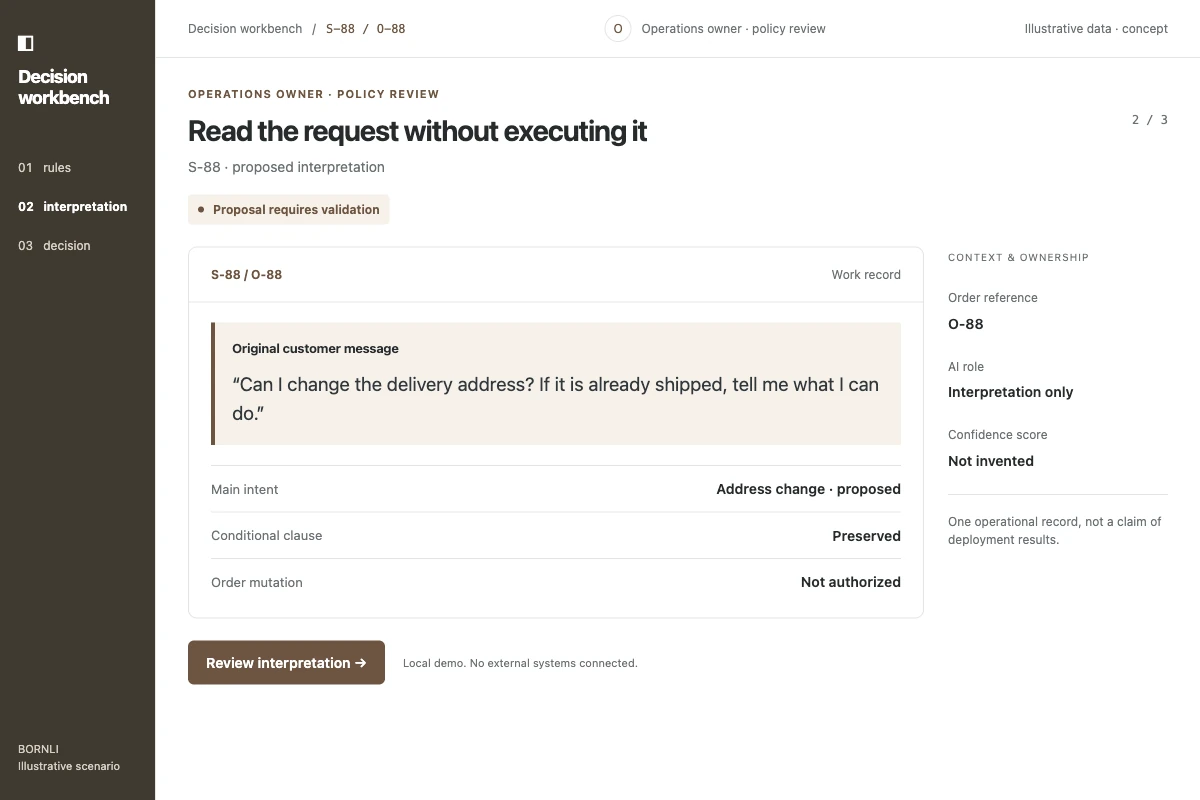
The free-form message contains a request and a fallback question. In the concept, AI proposes “address change” as the main intent and preserves the conditional clause. It does not edit the order. If the model reduces the message to “change address now,” the original text lets a reviewer spot the mistake.
Possible roles for AI include classifying a varied inbox, extracting a reference or drafting a response from approved material. Each needs its own evaluation examples. A correctly formatted output is not necessarily a correct interpretation, and a confidence label is not a calibrated probability unless you have validated it.
How does a hybrid workflow make the decision?
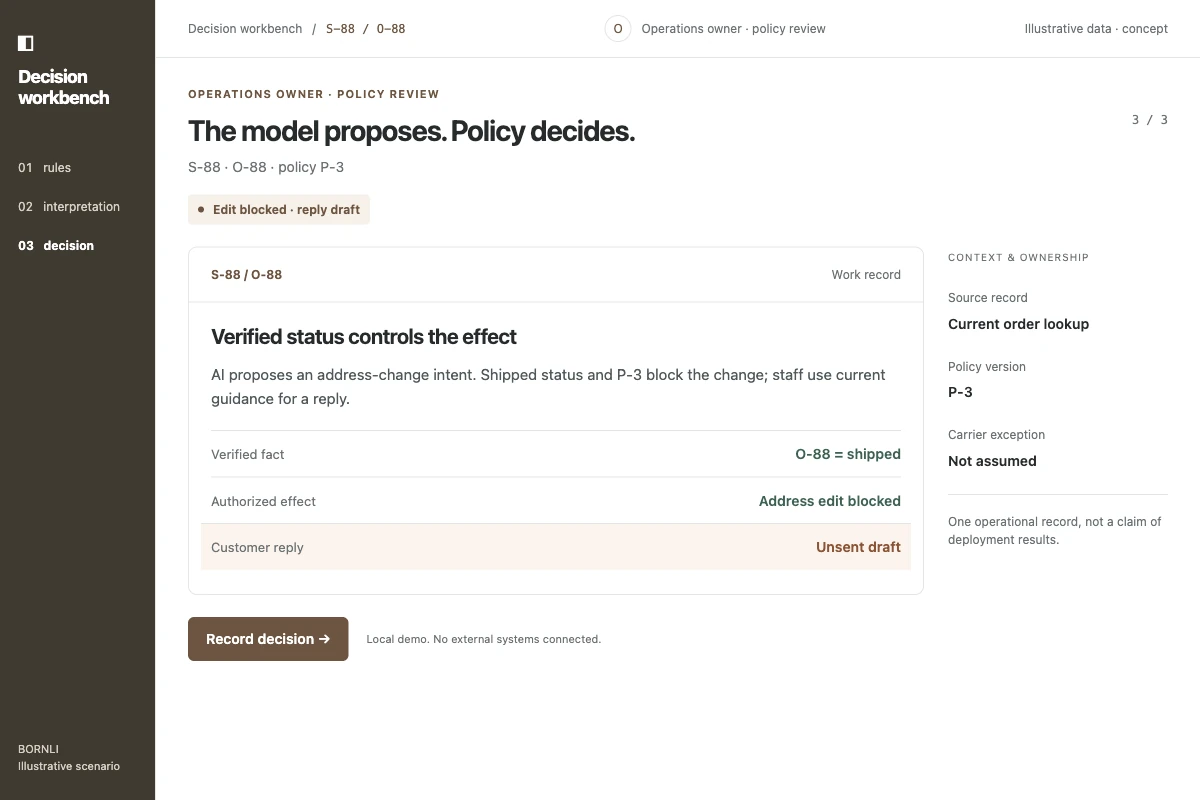
The proposed decision card combines the model’s label, verified status “shipped” and policy P-3. Automatic address change remains blocked. A person may send a response explaining the next permitted step, using current company guidance. The concept keeps that response as an unsent draft; it does not invent a carrier exception.
Store the source versions and the decision separately from any delivery receipt. If the order lookup fails, the workflow should pause or hand off. It must not use a previous customer’s status, a guessed default or persuasive text to continue.
How do you choose a sensible first implementation?
- Structured input, stable policy: start with rules and a standard connector.
- Varied text, reversible proposal: test AI interpretation with visible sources.
- Money, access or irreversible changes: require explicit authorization and authoritative checks.
- Missing business rules: resolve ownership and policy before choosing a model.
- Low volume with frequent exceptions: a clearer manual queue may be sufficient.
For the example, test an unshipped order, a missing order ID, a conditional request, contradictory status and a failed lookup. Evaluate wrong actions and review effort, not just the percentage of messages that received a label. Count model usage, integration work, monitoring and human review when comparing cost; this concept supplies no measured ROI or project price.
Start with a small, redacted set of real requests and the policy used by your staff today. Our pilot acceptance guide explains how to turn that decision into a testable scope. For an inbox that already has a clear routing policy, see the inquiry-routing example. The goal is an appropriate tool for one operation, not AI in every step.
Map the workflow before building it.
Tell us what your team handles manually, which tools you use, and where the process gets stuck. Start by email.
Discuss your workflow ↗