BORNLI / product decisions
Find the missing document before the project stalls
Compare a client’s files with the agreed onboarding checklist. Give a coordinator source-backed matches and missing items, then record the approved next action in the project system.
Which part of client onboarding should AI handle?
AI can help an onboarding coordinator compare incoming files with a defined checklist and prepare a list of missing or uncertain items. A useful first scope is document completeness for one service-project type. Keep decisions about client acceptance, identity, credit or launch approval outside that scope.
In a Microsoft customer story published September 24, 2026, BNY describes an agentic onboarding workflow that reviews new and previous documents. A BNY executive reports that AI assisted 25% of new onboardings that year and that those clients averaged 20% faster onboarding. Another passage narrows the improvement to certain processes. This is a vendor-published account, not an independent audit. We checked it on November 15, 2026. The result concerns BNY’s financial-services process; it is neither a BORNLI result nor a forecast for the service-company example below.
Our proposed workflow addresses a different, smaller problem: a signed-up customer has not supplied a complete implementation packet. It is distinct from routing a sales inquiry or entering a customer order.
What is the system checking against?
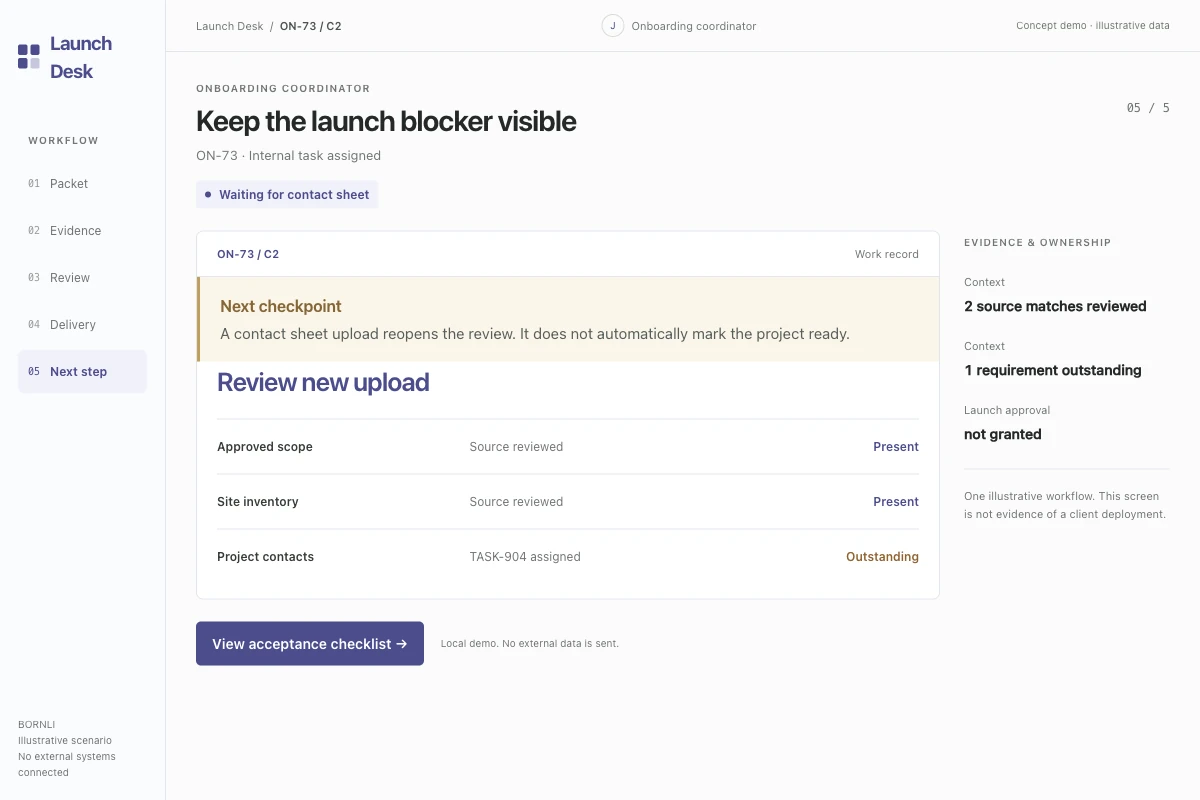
BORNLI concept demo — illustrative scenario. Service project ON-73 uses checklist C2: an approved scope, a site inventory and a project contact sheet. The folder contains scope-v3.pdf, sites-v1.csv and an exact duplicate of the scope file. Three uploaded files do not mean three requirements are satisfied.
Keep the project identity, checklist version, source files and access rules together. A coordinator should be able to see which checklist applied when the packet was reviewed. A later checklist change must not silently reuse a previous approval. Filenames help navigation, but the system should inspect the content rather than assume that a file called “contacts” contains the required information.
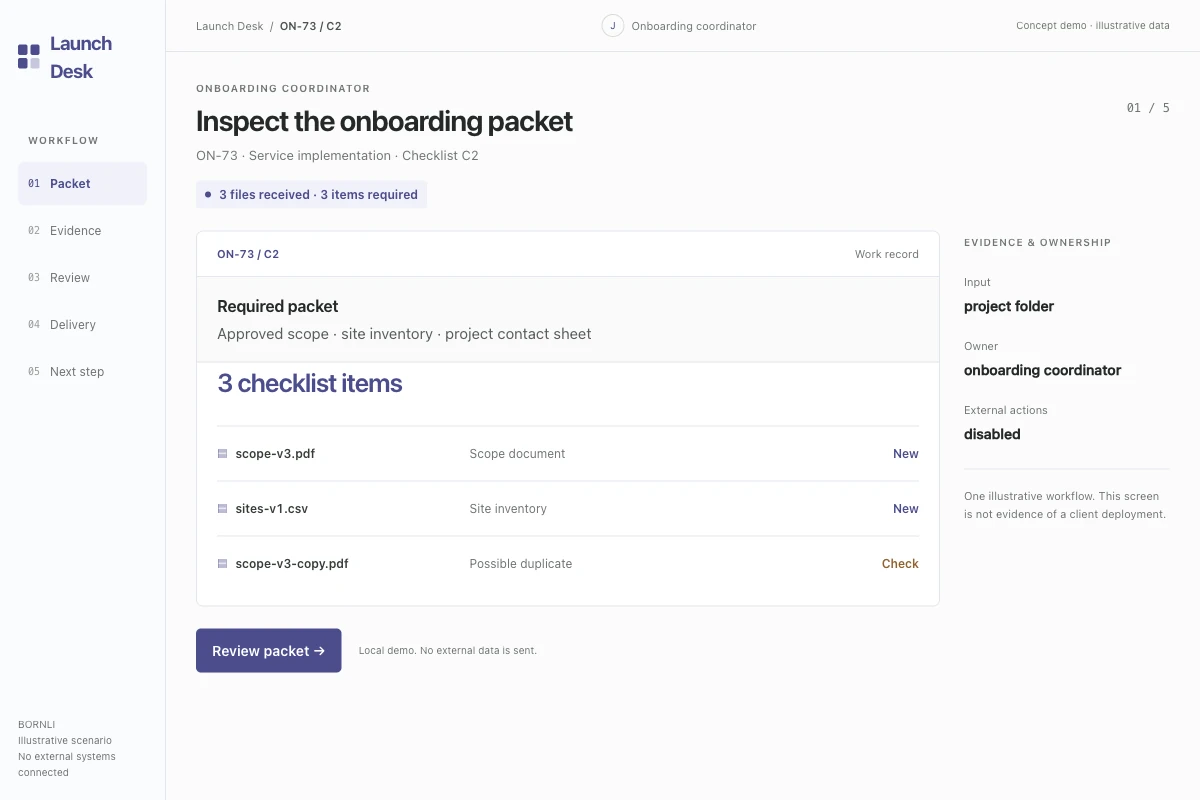
How does extraction become a reviewable match?
The proposed workflow reads document text, parses the CSV directly and proposes checklist matches. It links the scope to a page and the inventory to a row. It excludes the exact duplicate by file content, leaving two matched items and one missing contact sheet. A changed file needs a new review even when its filename is unchanged.
Azure Document Intelligence’s layout documentation, checked November 15, 2026, describes text and structure extraction, including source-position information. That is one possible component for supported documents. It does not supply the checklist, decide completeness or grant project-system access. A possible stack is a project folder, a document extractor, a structured CSV parser, a model for suggested matches and a review queue. Select the actual components after testing the team’s redacted files and access requirements.
Treat file contents as evidence, not instructions to the automation. A sentence inside a PDF cannot remove a checklist requirement or authorize a client message. If evidence is unreadable or contradictory, return an uncertain item instead of inventing a match.
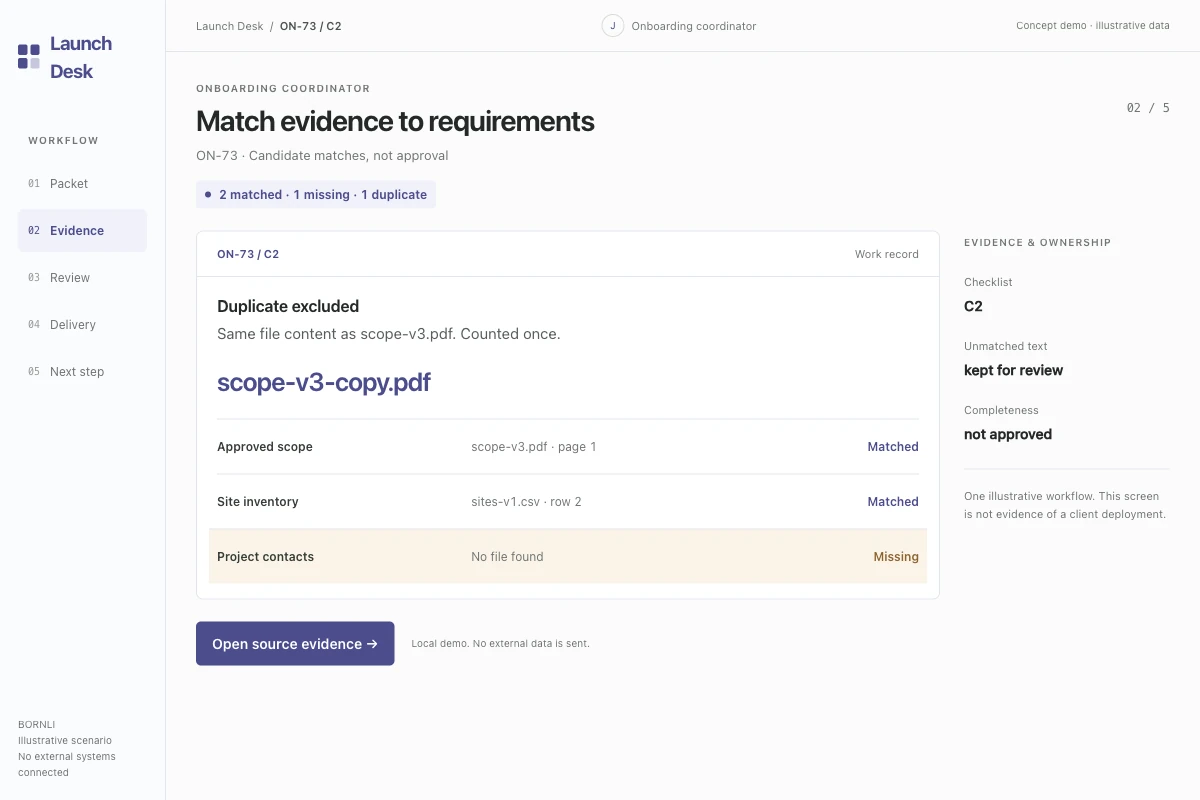
What does the coordinator approve?
The coordinator opens the source locations, confirms the two matches and checks that the contact sheet really is absent. The draft follow-up asks for the project owner, escalation contact and preferred contact channel. It uses the approved checklist rather than adding requirements improvised by a model.
Approving this follow-up means the gap description is ready for an internal task. It does not mean the packet is complete, the customer has been contacted or the project is ready to launch. Keep those states separate. The pilot should also let the reviewer reject a proposed match and record why.
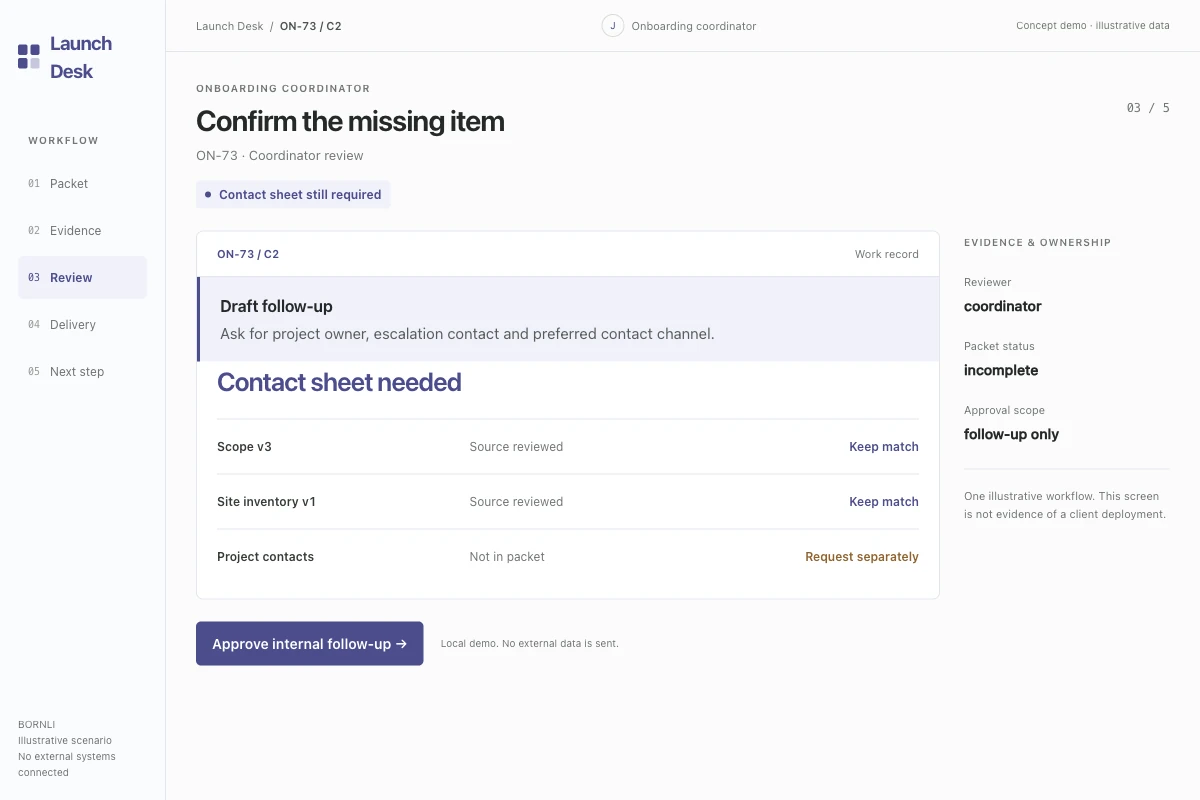
How does the follow-up reach the project system?
The approved action creates an internal task linked to ON-73 and checklist C2. It carries the missing item, source links and reviewer decision. In the illustrative failure case, the task-system response is lost. A lookup finds TASK-904, so the workflow records its receipt instead of creating another request.
Design this handoff around a stable operation identity and an actual destination lookup. If the destination cannot support safe reconciliation, send the ambiguous operation to a person. A retry button must not multiply tasks or emails. These are proposed integration requirements; the concept has no live project-system connection and sends no client messages.
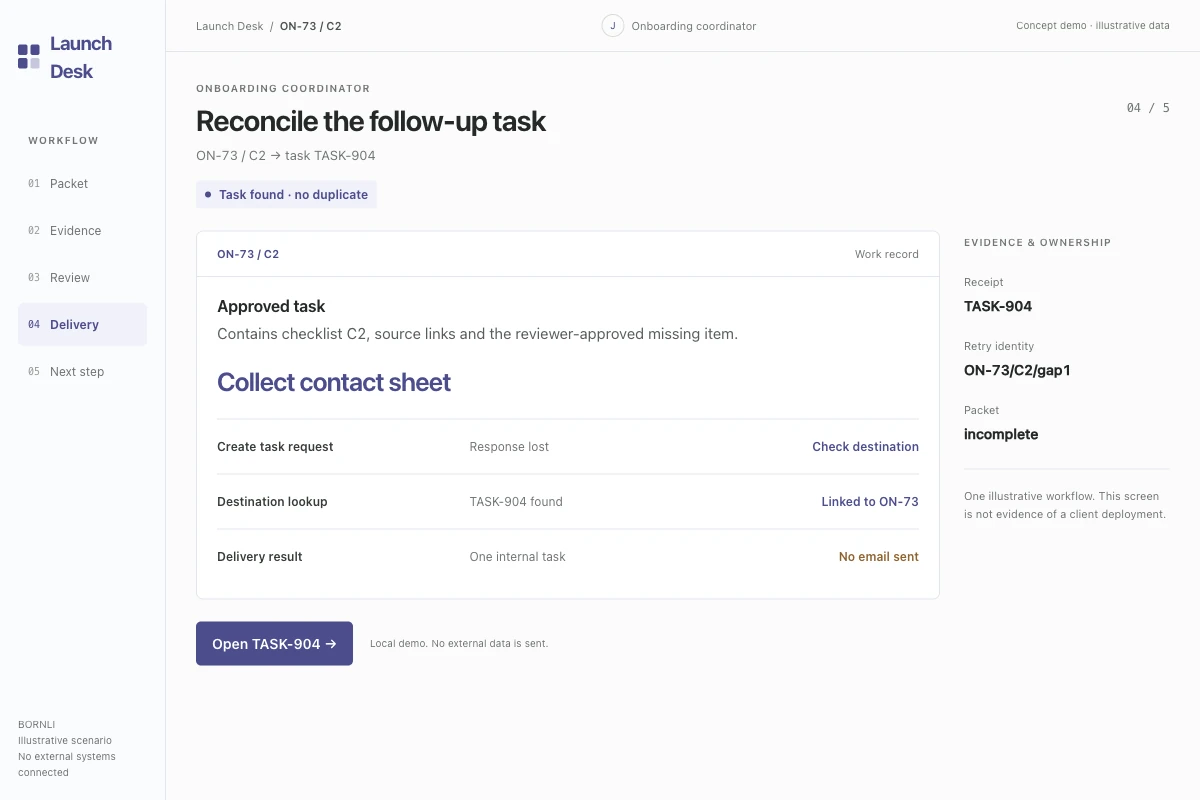
What is the useful result if a document is still missing?
The result for ON-73 is deliberately incomplete: two source matches have been reviewed and TASK-904 tracks the outstanding contact sheet. That is more actionable than a vague “processing complete” badge. The coordinator knows what is missing and where the follow-up lives.
A new contact-sheet upload starts another evidence review; it does not automatically grant launch approval. If the scope or checklist changes first, the existing matches must also be rechecked where affected. The final business decision stays with the designated project owner.
How should the team judge a pilot?
Start with one onboarding checklist, one project type and an internal-only task handoff. Test complete packets, a missing item, an exact duplicate, a misleading filename, a revised document, unreadable evidence and a lost task response. Include examples that look complete but are not; otherwise the test mostly rewards the easy cases.
Measure missed gaps, incorrect “complete” decisions, reviewer corrections, review time and duplicate tasks. Count processing cost and time spent repairing exceptions as well. Set acceptance thresholds with the team before testing; there is no universal percentage that proves this workflow safe or worthwhile.
No client deployment or savings are claimed for this concept. The BNY figures above describe a different organization and process. For a project estimate, bring a redacted checklist, a few complete and incomplete packets, the destination system and the person who can approve the next action. The pilot-scoping guide explains how to turn that evidence into a bounded first release.
Map the workflow before building it.
Tell us what your team handles manually, which tools you use, and where the process gets stuck. Start by email.
Discuss your workflow ↗