BORNLI / product decisions
AI supplier order acknowledgment with buyer-controlled exceptions
AI can prepare a comparison between a supplier acknowledgment and the purchase order your company already issued. The buyer should resolve changed dates, quantities and prices before an approved update reaches the purchasing system.
Catch a changed supplier promise before it becomes a planning surprise
AI supplier order acknowledgment processing helps a purchasing team compare an incoming confirmation with an already-issued purchase order. The output should be a reviewable list of differences, followed by a buyer-approved update. Reading a supplier's proposed change does not mean accepting it.
There is a relevant public example. In its September 11, 2025 HOERBIGER case introduction, Netfira describes automating order confirmations, shipping notices and customer orders, and reports improved planning accuracy and time savings. This is a vendor-reported qualitative result. The public introduction does not give a measurement period or quantified saving; the full case requires a form and was not accessed. It is not a BORNLI project or an independent audit.
Netfira's current confirmation-processing page describes line-level PO matching, tolerance checks and exception routing. Its August 21, 2025 explanation of AI places AI assistance around connection setup and exception handling, with configured business rules. Those descriptions do not prove a particular model or accuracy rate in the historical customer project. They do support a practical design distinction: extraction, comparison and purchasing authority are separate tasks.
The workflow below is an illustrative scenario and BORNLI concept demo. All supplier records, document IDs, dates and decisions are fictional. It concerns a supplier answering our purchase order; customer sales-order intake starts a different transaction.
Link the acknowledgment to the issued order revision
A buyer receives supplier confirmation ACK-903 for PO-762 revision 2. The original order requests 120 EA of part VAL-20, at $18 each, due December 2. The supplier confirms the same quantity and unit price but proposes December 7. The attachment remains visible beside the issued order.
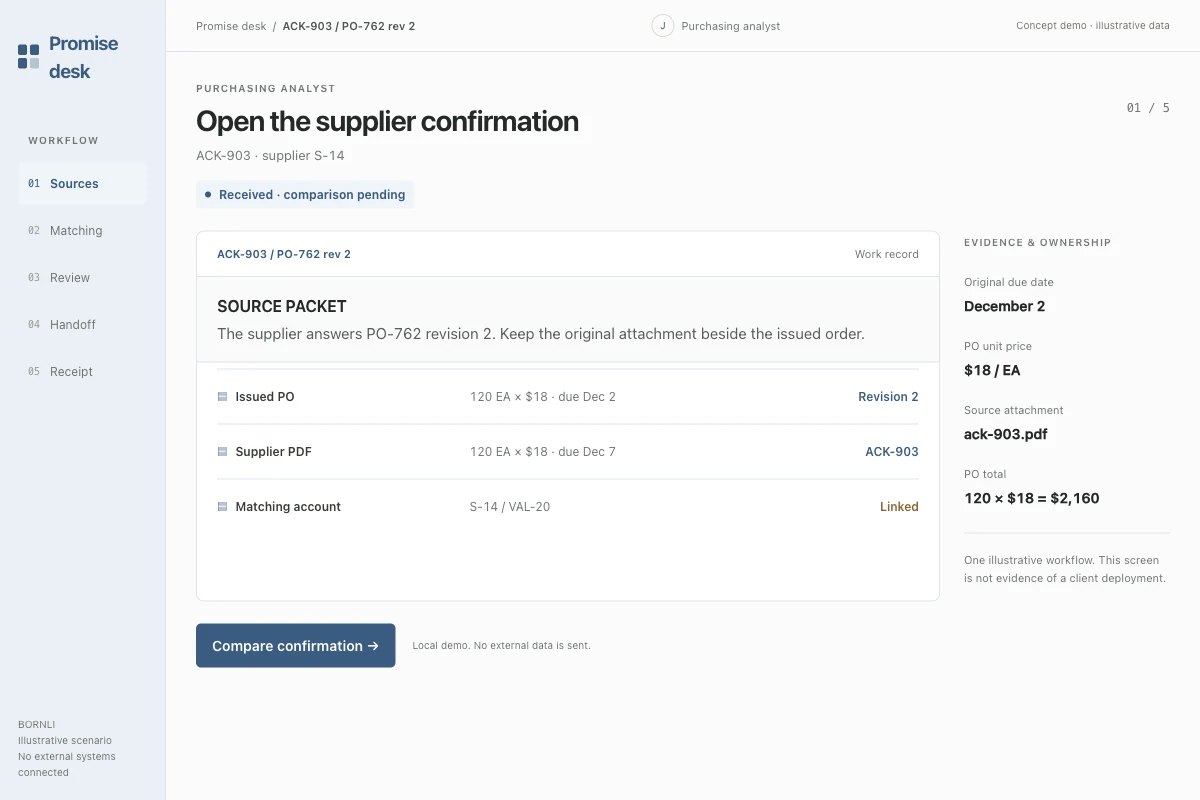
Store the original document and sender reference without rewriting them. Resolve the supplier account, PO number and revision before comparing lines. A confirmation for an older revision or an unknown order should enter a separate queue; matching only on a similar amount is not enough.
For the proposed pilot, a monitored intake or controlled upload feeds document storage, a structured extraction step and a read-only PO lookup. The supplier message is input data, not permission for the model to change approval rules or call purchasing actions. Limit the extraction output to the fields the comparison actually needs.
Show the original value and the proposed value on the same line
The comparison identifies one exception: delivery moves from December 2 to December 7, a difference of five calendar days. Quantity remains 120 EA and unit price remains $18. The model can locate and label these values; explicit comparison rules calculate differences and decide which fields require review.
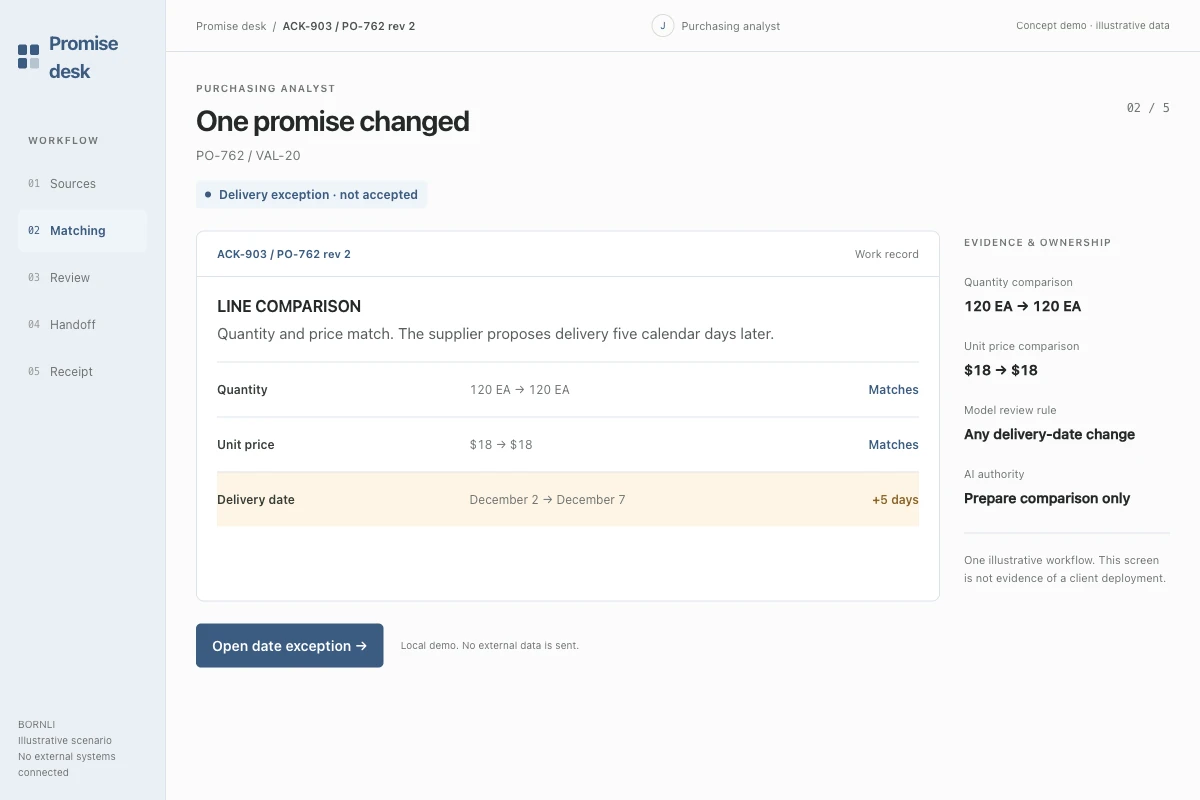
In this scenario, any changed delivery date requires a buyer decision. That is an illustrative rule, not a universal threshold. A production policy can vary by item, supplier or purchase agreement, but its version must be visible and testable.
Handle missing lines, split shipments and substitutions separately. A confirmation for 80 EA now and 40 EA later still totals 120 EA, but its schedule is different. A document that says a date is tentative should not become an unconditional commitment because the extractor found a valid calendar value.
When a supplier uses a different part number or unit, show the proposed mapping and its source. Do not compare a price per box with a price per individual item. An unclear mapping remains unresolved until the buyer or a maintained reference table establishes it.
The buyer accepts or challenges the change
The buyer checks the highlighted supplier date and the internal need date of December 9. For this fictional order, the buyer records a decision to accept the December 7 promise, with a note that the schedule was checked. The original December 2 request remains in the history.
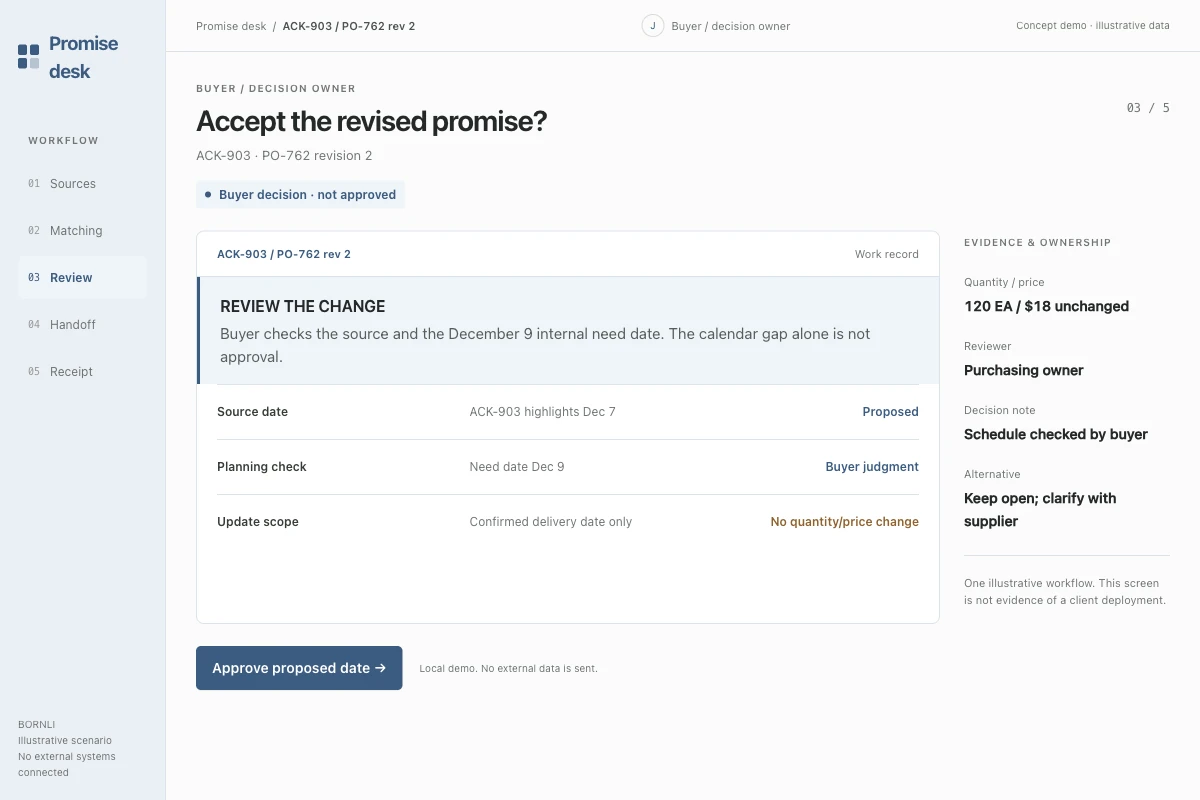
The two-day interval before the internal need date is not proof that the change is safe. Receiving, inspection, transport and production dependencies can require more time. The responsible employee must make that decision using the organization's actual planning rules; the model should not infer permission from the calendar alone.
Offer an explicit alternative: keep the exception open and request clarification. If a different quantity or price is later accepted, bind that decision to a new comparison version. A reviewer should never approve one document while a background process silently replaces it with another attachment.
Send the approved schedule with a stable update identity
The approved update UPD-903 records ACK-903, PO-762 revision 2, the affected line, the buyer's decision and the proposed December 7 supplier date. Before delivery, the integration checks that the PO has not changed since review. A newer PO revision sends the item back for reconciliation.
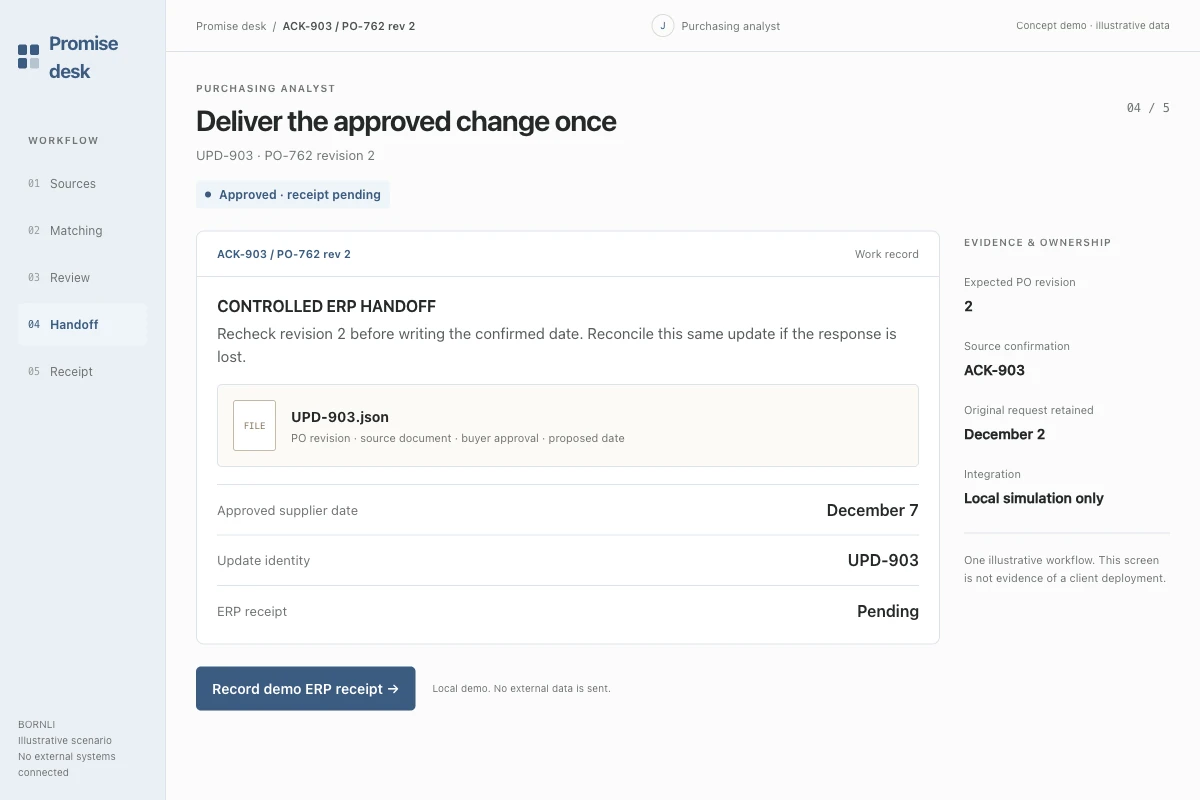
The suggested implementation uses a durable work queue and a narrow ERP adapter for the confirmed-schedule field. It does not grant the extraction model general purchasing access. Preserve the initial requested date in an audit trail even if the ERP uses a different field structure.
A timeout leaves the result unknown. Look up UPD-903 in the destination before retrying, or use a destination-supported repeat key. Do not invent a new update identifier simply because the first response was lost. If the ERP lacks that capability, agree a reconciliation procedure before enabling writes.
The handoff screen says Receipt pending until a destination response is recorded. A queue receipt may mean accepted for processing rather than committed to the PO. Verify the actual meaning in the chosen ERP before presenting the update as complete.
A recorded promise is not a received shipment
In the completed local scenario, demo receipt ERP-662 confirms the approved schedule update. PO-762 now records a December 7 supplier promise for 120 EA, with the original request and buyer decision retained. The goods-receipt status remains Not received.
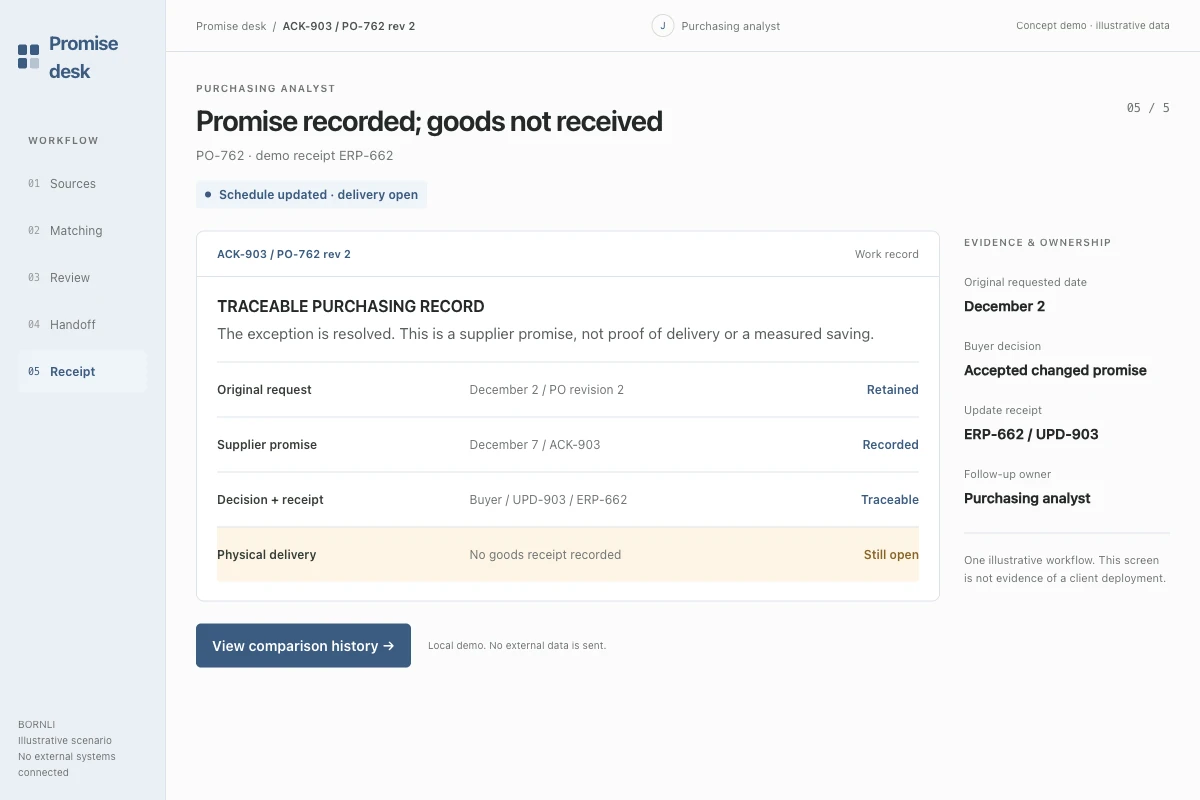
The useful outcome is a traceable purchasing record and a resolved exception with a known owner. The concept does not demonstrate an on-time delivery, avoided production delay or financial saving. Those outcomes require later operational evidence.
A replacement acknowledgment should reopen comparison against the current order state. A repeated copy of ACK-903 should link to the existing record. Keep supplier-promise tracking separate from checking an invoice for payment; approving a delivery date does not authorize an invoice.
Measure missed deviations as well as time spent
Start with one buyer team, one ERP entity and a small supplier group with repeatable confirmation formats. For the first supervised release, require review of every proposed update. Exclude multi-order acknowledgments, undocumented unit conversions and substitute materials until their rules have been tested.
- Reference set: have buyers label historical documents, including unchanged confirmations, late dates, missing lines and ambiguous units.
- Difference quality: count missed changes and false exceptions separately; a fast extractor that hides a late date fails the task.
- Human effort: include source checking, clarifications, corrections and integration recovery when measuring handling time.
- Handoff reliability: test a changed PO revision, duplicate attachment, rejected write and lost response.
- Operational follow-up: distinguish the recorded supplier promise from the actual goods-receipt date.
The Netfira story supplies external context; its reported benefits are not a forecast for this pilot. BORNLI's next step is to review a redacted confirmation, the matching issued PO, the exception policy and ERP update method, then agree the scope and acceptance criteria. Price and timing depend on that assessment.
Map the workflow before building it.
Tell us what your team handles manually, which tools you use, and where the process gets stuck. Start by email.
Discuss your workflow ↗