BORNLI / product decisions
A return request is not a refund approval.
Let AI prepare the request and evidence. Keep policy exceptions, return creation and money movement as separate, visible decisions.
What should AI do in a returns workflow?
AI can read a return request, identify the relevant item and prepare the evidence an agent needs. A useful first pilot handles one store, one return category and one approved policy. It should not treat a persuasive customer message as authorization to issue money or override an exception.
In Gorgias’ Orthofeet story, the vendor reports automating 56% of support tickets in under two months. It also shows a return inquiry receiving instructions and a portal link. The percentage covers support tickets overall, not refunded returns alone. Exact calendar dates and the denominator are not disclosed; this is vendor-reported, not an independent audit or a BORNLI result. Source checked November 13, 2026.
There is also an important implementation boundary: Shopify’s 2026-07 returnCreate documentation says the mutation creates an OPEN return and assumes the request has already been approved. It is therefore not the step to use merely because AI recognized a return request. Permissions and the precise return flow must be validated for the store.
Which order and item does the customer mean?
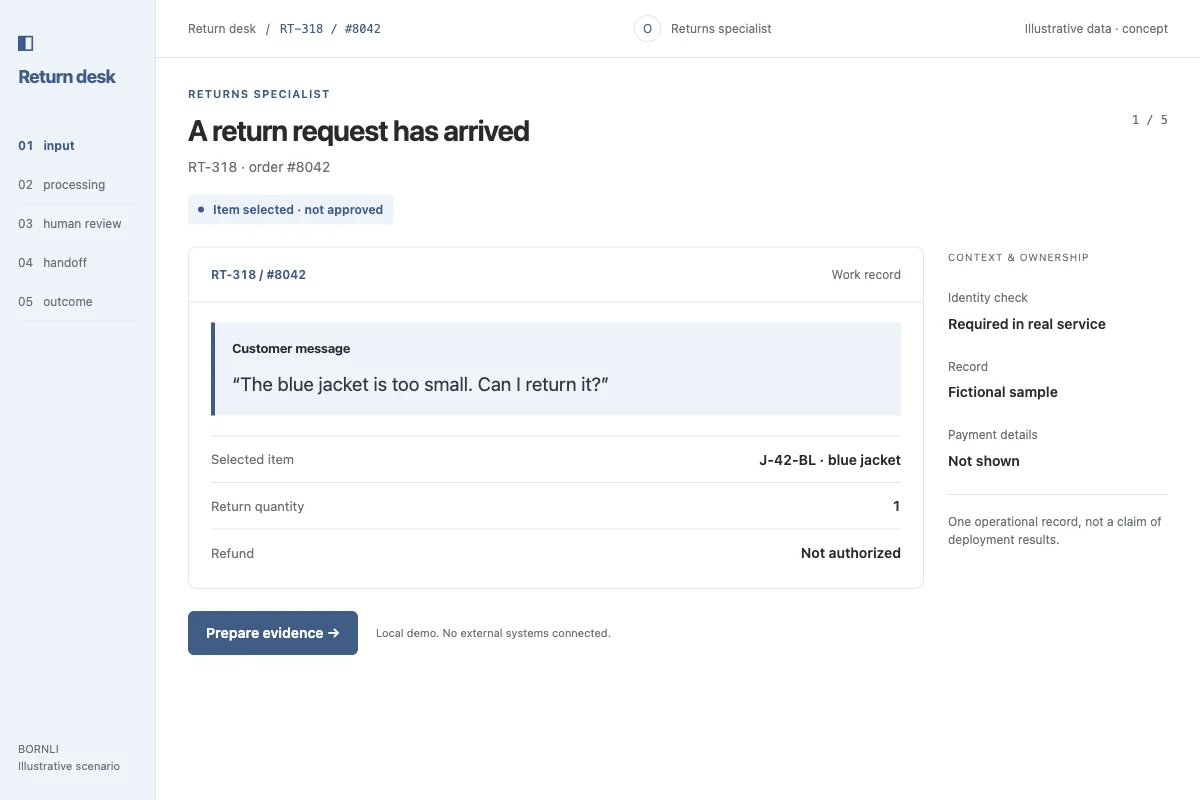
BORNLI concept demo — illustrative scenario. Request RT-318 refers to order #8042: “The blue jacket is too small. Can I return it?” The order has two line items. The selected jacket is SKU J-42-BL, quantity one. The demonstration uses fictional records, with no customer identity or payment data.
The intake stores the original message and the selected fulfillment line. Before exposing order details, the real service needs its approved identity-checking flow. If the order or item cannot be resolved, the workflow asks for clarification or routes to staff; it does not select the first matching name.
How should policy checks work?
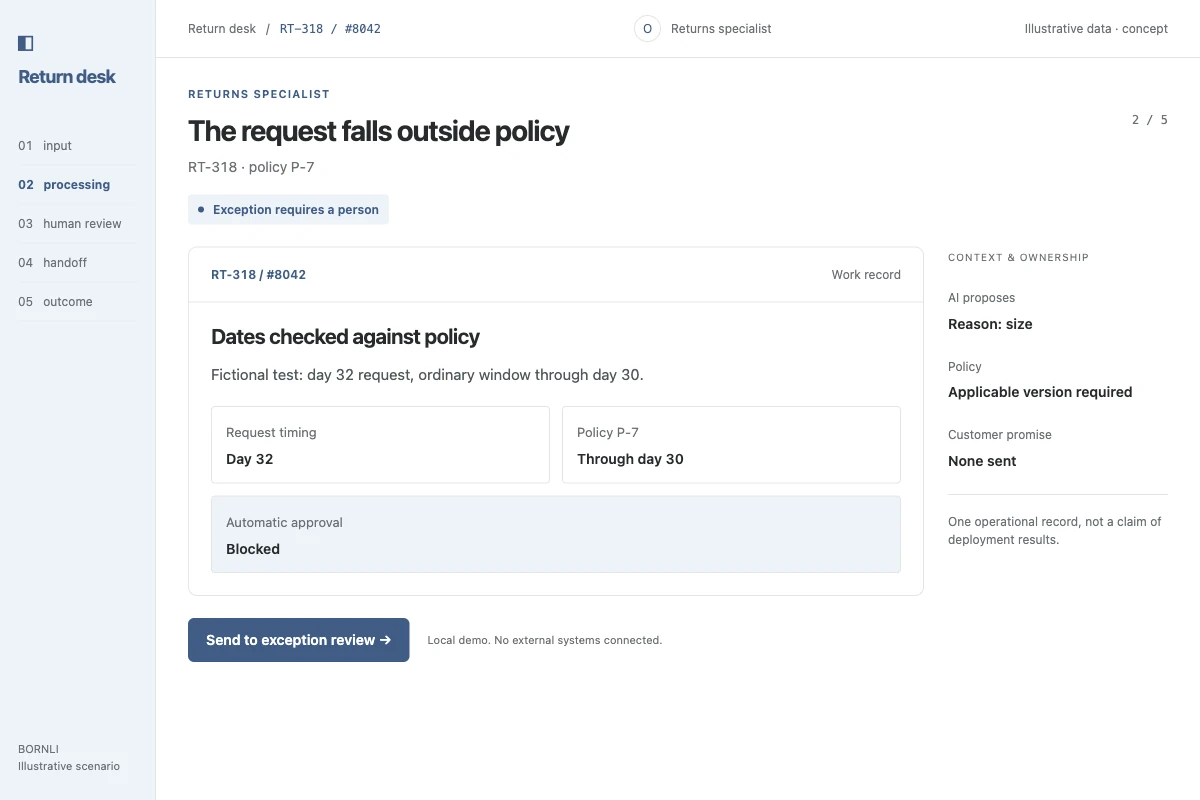
In the model, the request arrived on day 32 after delivery; policy P-7 allows ordinary returns through day 30. These are deliberately invented test values, not advice about a store’s legal obligations or a universal return policy. AI identifies the reason “size”; a deterministic check marks the date as an exception.
The evidence panel shows delivery date, request date, the policy version that applies to this order and any existing return. Ambiguous delivery events or conflicting dates pause the decision. The assistant drafts a neutral acknowledgment for review. It does not send a guaranteed refund amount or silently substitute today’s policy for the applicable one.
Who approves an exception?
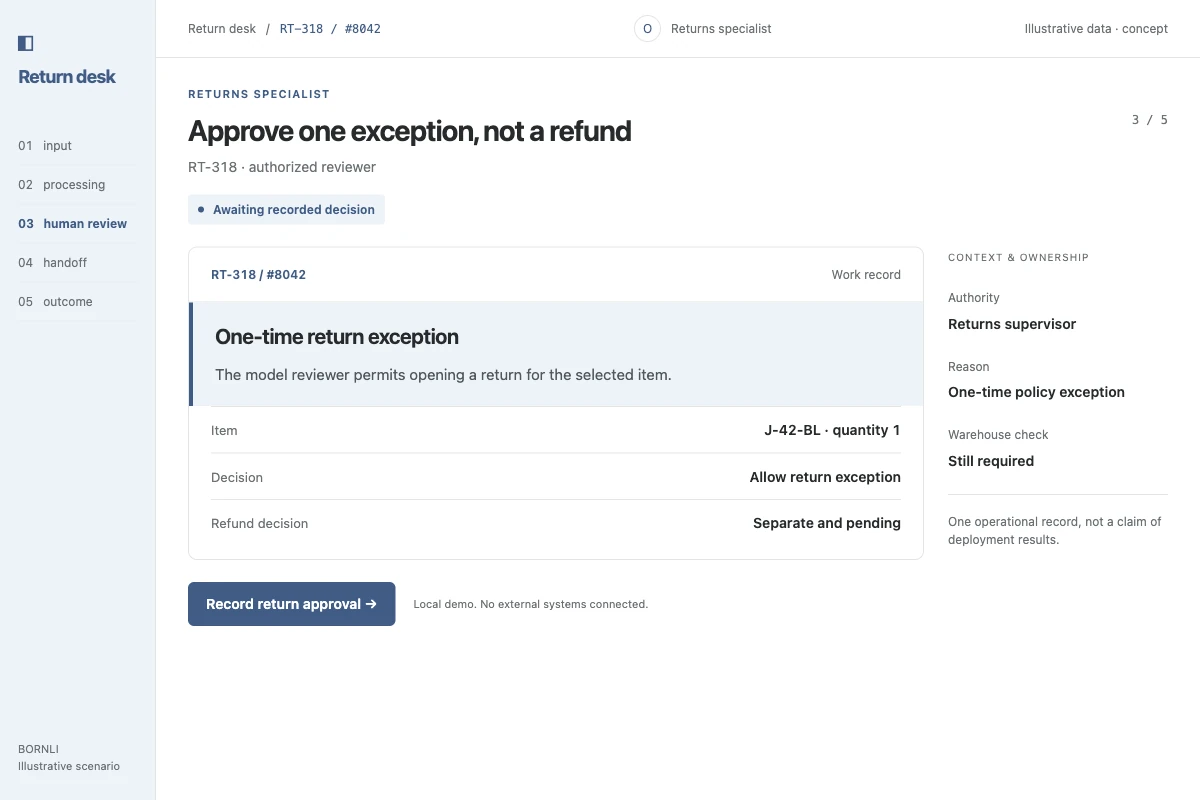
An authorized agent reviews the dates and approves a one-time exception for the selected item in this fictional example. The record stores that decision and its reason. If the reviewer lacks the required authority, the next action is escalation, not an enabled approval button.
Approval here means permission to open a return under the agreed process. The warehouse may still need to receive and inspect the item before a separate refund decision. Partial returns, already refunded items and disputed payments belong in explicit test cases or outside the initial scope.
What happens when the platform response is lost?
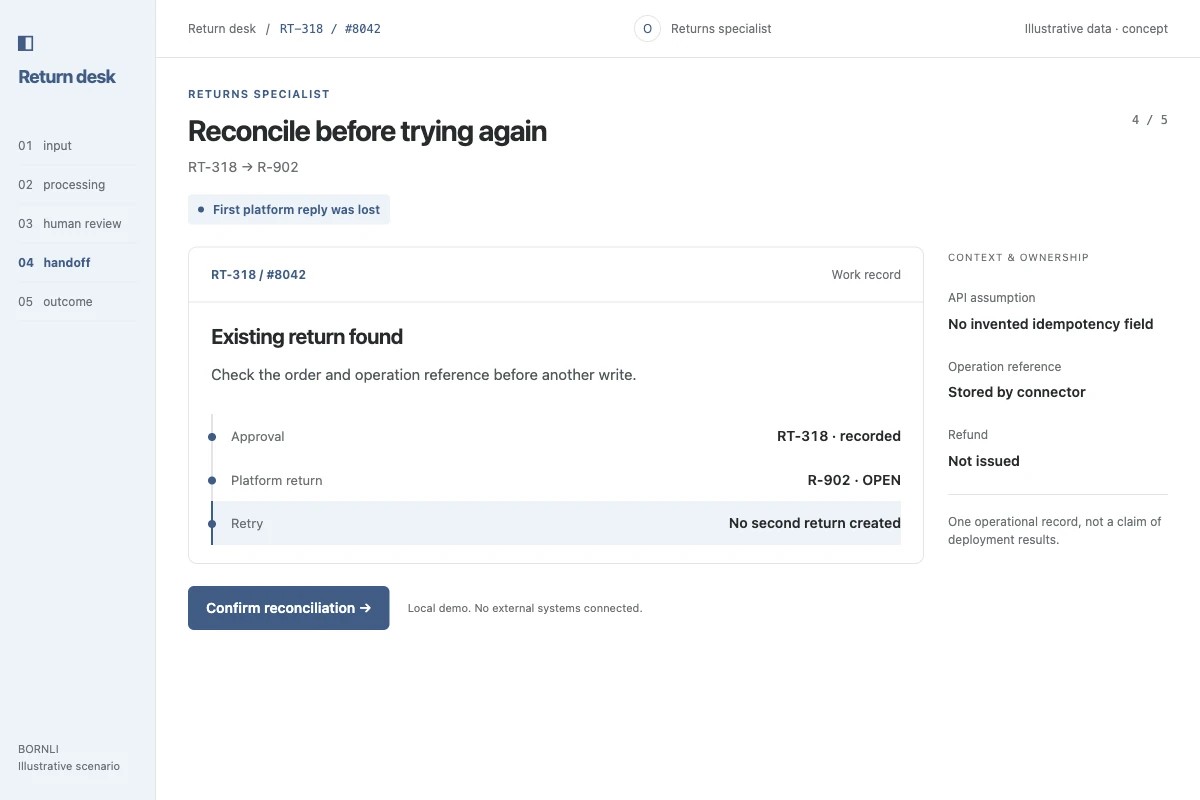
The approved request is handed to the store’s return workflow. In the concept, the first response is lost. The connector does not blindly create another return: it checks the current order and stored operation reference, then reconciles to return R-902. The request stays visible while that result is uncertain.
This reconciliation is an implementation requirement, not a claim that every API call is automatically idempotent. Store the returned platform ID, approval reference and operation status. Do not add a made-up idempotency parameter to a mutation that does not document one. Creating the return and confirming a refund remain separate operations.
What does a successful result mean?
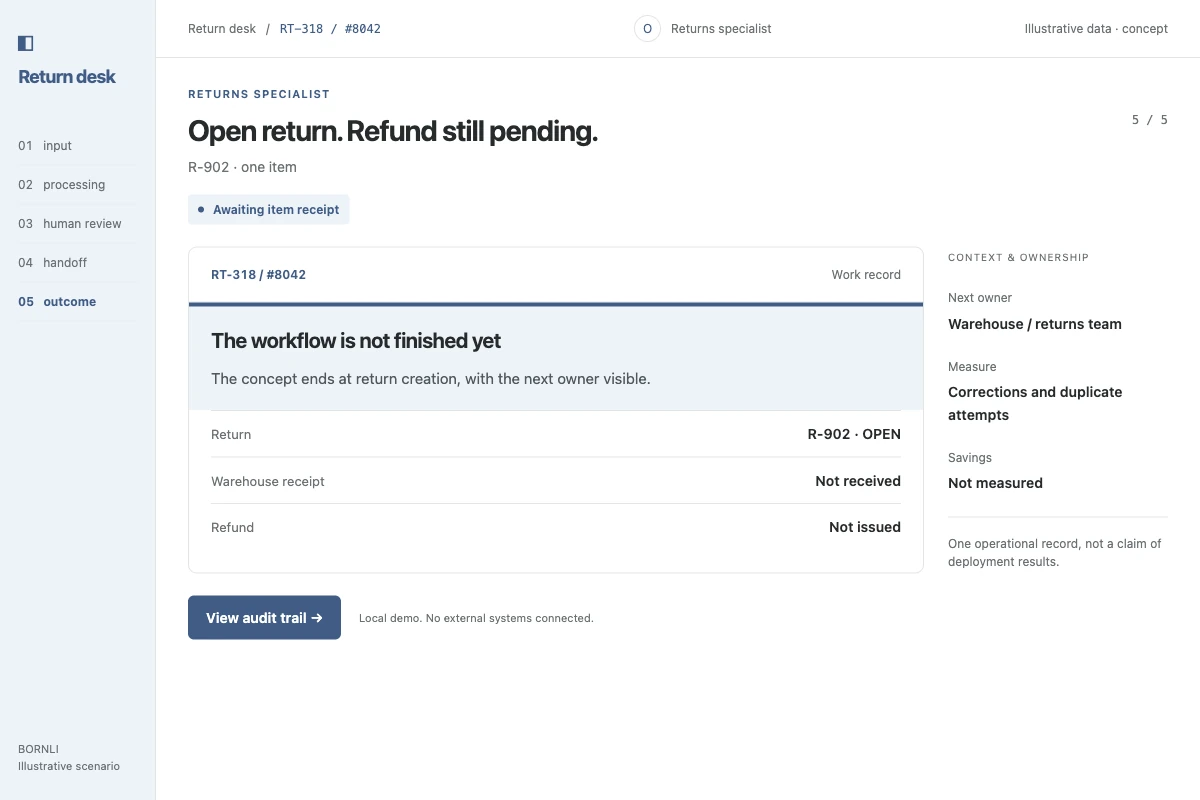
The model ends with one OPEN return R-902 for one item. The item has not yet been received and no refund has been issued. The local concept demonstrates those states and a review trail; it is not connected to Shopify and does not prove a production integration.
Measure time to a correctly prepared request, reviewer corrections, duplicate return attempts and unauthorized promises. Keep later refund accuracy and customer recontacts visible too. A high automated-ticket rate alone can hide unfinished work. Orthofeet’s reported rate does not predict your results, and we claim no measured savings for this concept.
What belongs in the first pilot?
Use a small redacted sample, the policy versions that actually applied, an order lookup and a sandbox return flow. Test an unknown item, the edge of the return window, an already open return, a changed order, a revoked permission and a lost response. First run in review mode; enable platform writes only after the acceptance cases pass and the responsible team approves the scope.
For general customer inquiries, see shared-inbox routing. For selecting a bounded implementation, use the workflow pilot checklist. BORNLI starts with the operation, authority and integration boundary; price and schedule follow that scope, not an assumed percentage of automated tickets.
Map the workflow before building it.
Tell us what your team handles manually, which tools you use, and where the process gets stuck. Start by email.
Discuss your workflow ↗