BORNLI / product decisions
AI cash application with evidence for every invoice match
AI cash application can prepare a proposed allocation of an incoming customer payment to open invoices. Finance staff should see the source, settle ambiguous references and approve the allocation before the accounting system posts it.
Help the analyst allocate received payments to the right invoices
AI cash application can extract remittance details and propose how an incoming customer payment should be allocated to open invoices. It suits a B2B receivables team that repeatedly compares bank records, emailed remittances and customer ledger entries. The useful output is a reviewable allocation with evidence for each invoice match.
There is a relevant external example. Billtrust reports that Malin, a Raymond company, reduced its daily cash-application process by 75%, or six hours, after adopting Billtrust Cash Application. This is a vendor-reported historical result, not an independent audit. The page does not disclose the cash-application measurement window or detailed timing method. It also discusses other Billtrust products and separate collections results; those outcomes should not be attributed to this single task.
Billtrust's current product description covers AI matching, OCR and exception handling. That does not establish which model or features produced the historical Malin result. Both pages were checked November 20, 2026.
Our separate illustrative scenario is a BORNLI concept demo with fictional records and amounts. It covers accounts receivable: money already received from a customer. Supplier invoice verification is an accounts-payable task with a different decision and should not be mixed into this workflow.
Keep the bank record and the customer's instructions separate
Payment PAY-608 records USD 9,900 received from customer C-104. An emailed remittance has two invoice lines. The bank record establishes the received amount; the remittance describes how the customer intended to allocate it. Neither source should silently replace the other.
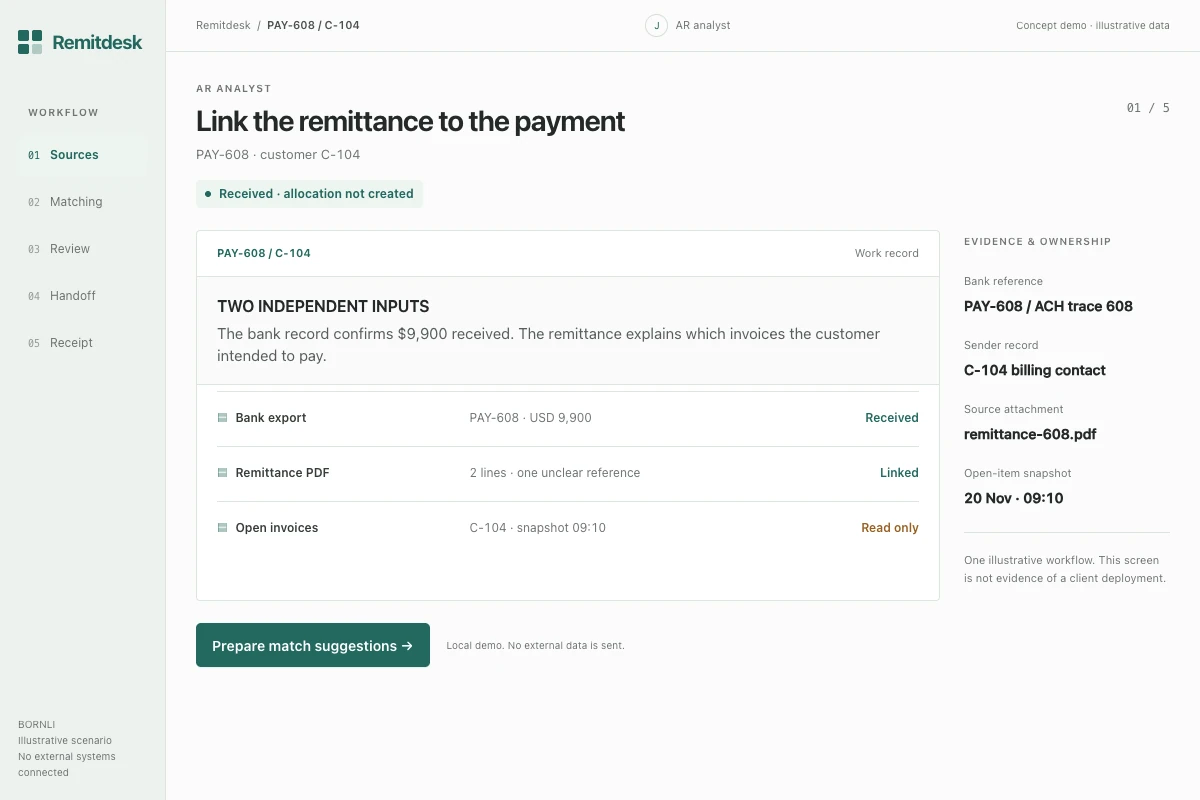
The proposed pilot uses a controlled remittance inbox, a read-only bank export, an open-invoice snapshot and a review queue. Store the source document, received timestamp and payment reference beside the extracted fields. Give analysts access to the records they need; a model does not need permission to move money.
Link a forwarded or duplicate remittance to the same payment. If the customer identity is uncertain, hold the packet before matching invoices. A familiar company name in an email is insufficient on its own to choose a ledger account.
Use AI for the unclear document, explicit checks for the money
The first remittance line clearly identifies invoice 8421 and USD 6,000. The second shows an unclear reference, 842?, with USD 3,900. Two open invoices, 8422 and 8427, each have a USD 4,000 balance. Choosing the nearest amount would not resolve the ambiguity.
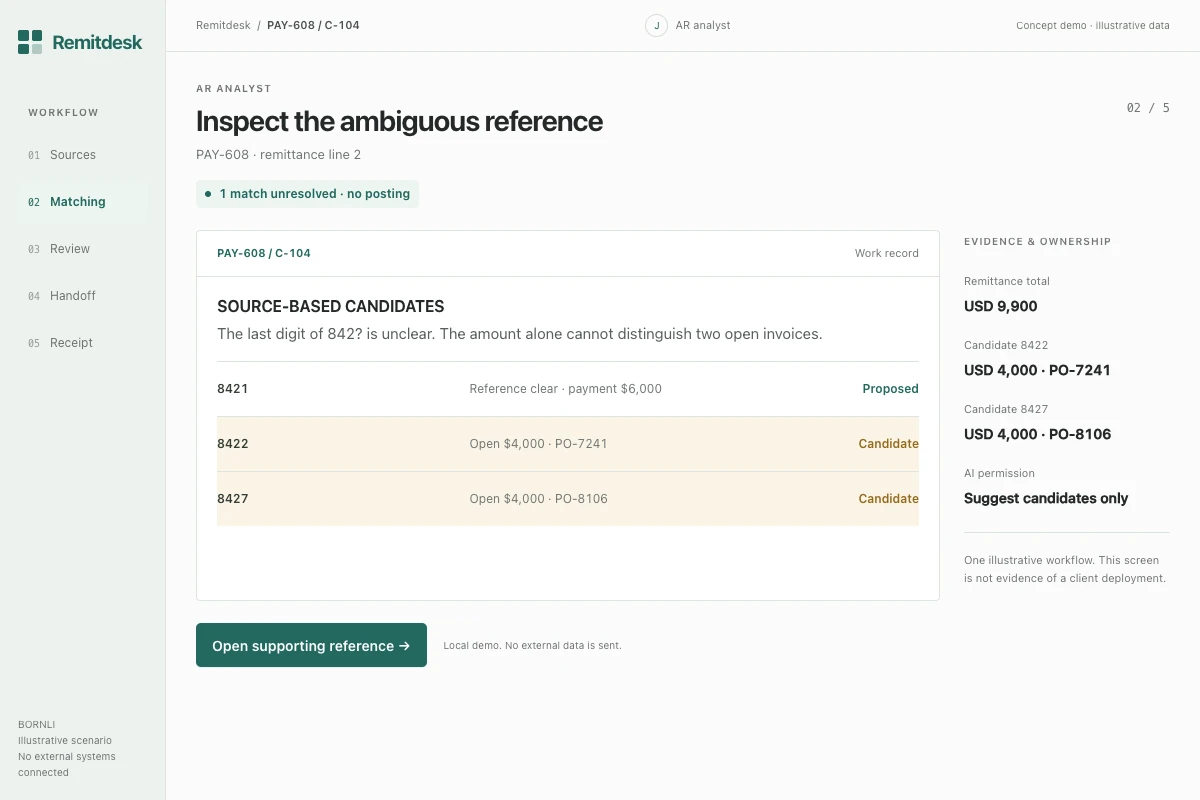
The assistant presents both candidates and the relevant source fragment. A supporting purchase-order reference, PO-7241, points toward invoice 8422. The analyst still needs to confirm that evidence. Keep the model's extraction separate from the ledger data it is compared against.
Use ordinary checks for currency, payment identity and arithmetic: 6,000 plus 3,900 equals 9,900. Requiring the allocation to balance is necessary, but a balanced allocation can still name the wrong invoices. Avoid a single green confidence score that hides that distinction.
Approve the intended invoice without inventing a write-off
The analyst verifies PO-7241 against invoice 8422, then approves USD 6,000 for invoice 8421 and USD 3,900 for invoice 8422. The full payment is allocated. Invoice 8422 still has USD 100 outstanding.
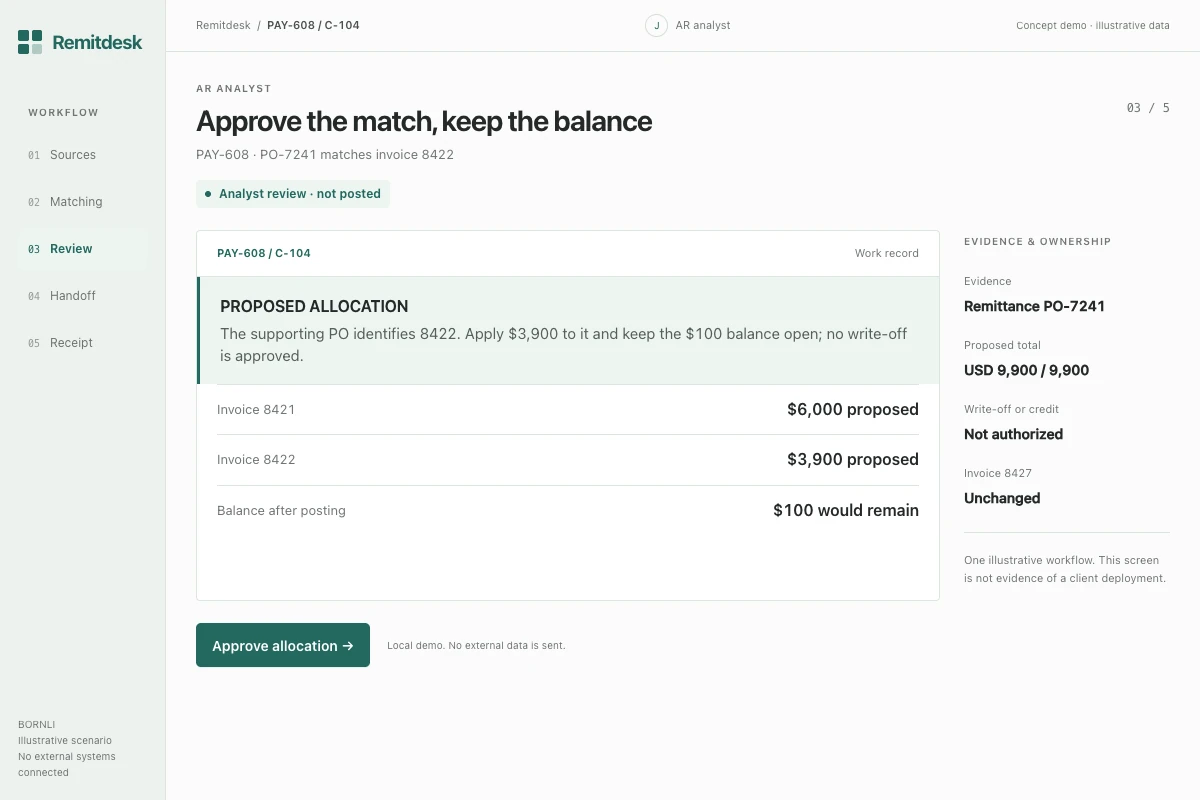
Do not convert that USD 100 into a discount, credit or write-off simply to clear the exception. Record the short-paid balance and route it for investigation under the company's existing policy. Invoice 8427 remains unchanged.
Microsoft's Business Central documentation, updated November 16, 2026, describes reviewing suggested applications, changing applied amounts and explicitly accepting a reviewed application. It also restricts a payment application to entries for one account. This documents that product's workflow; it is not evidence of a live BORNLI connector.
Hand off the approved allocation with a durable receipt
The approved draft, AL-608-v1, contains the customer account, currency, payment reference, two invoice allocations, reviewer identity and source links. Before posting, recheck the open balances. Another payment or credit may have changed them since the analyst opened the packet.
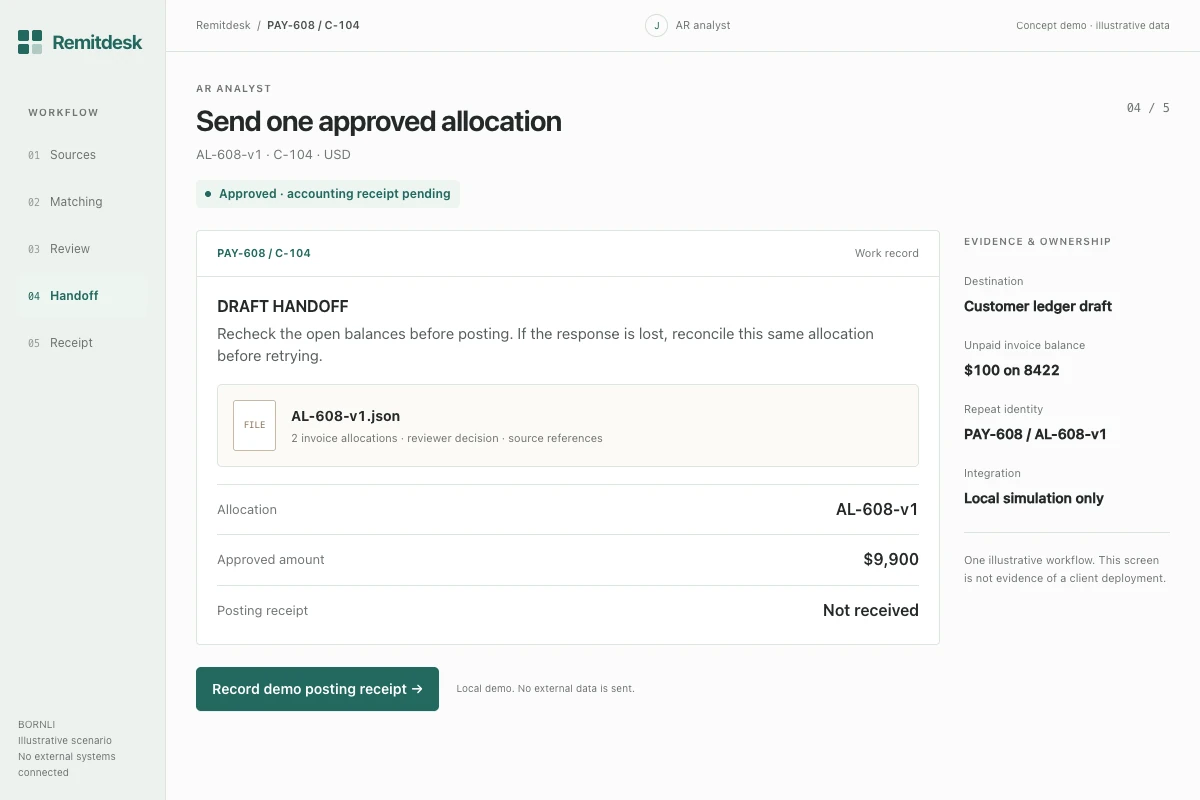
The accounting system remains the ledger of record. Start with a reviewed import or draft integration whose permissions match the pilot; do not presume a connector can post the required transaction. Agree with the system owner what its receipt means and how to reconcile a lost response.
Use the same payment and allocation identity on retry. If the destination already accepted AL-608-v1, read that result rather than apply PAY-608 again. A changed allocation needs another review. Currency conversions, credit memos, payment discounts and cross-account settlements stay outside this first pilot until their rules are specified.
Show what is complete and what remains collectible
The concept records demo receipt CR-2192. USD 9,900 is allocated, so unallocated cash is USD 0. Invoice 8421 is settled in the model, while invoice 8422 still has USD 100 due. Those are compatible states: allocating a payment does not mean every invoice is fully paid.
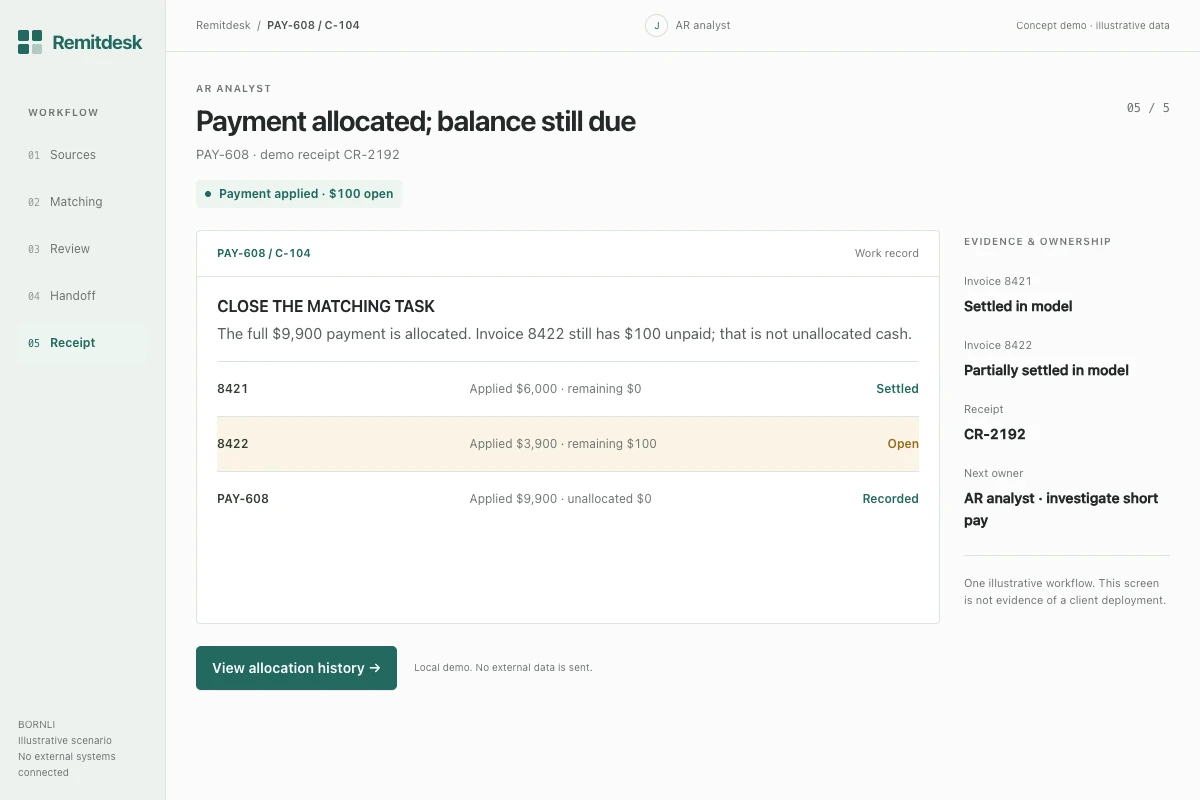
The useful result is an auditable matching decision and an owned follow-up for the short payment. Keep the original remittance, the supporting PO reference, the analyst's decision and the destination receipt together. The local prototype simulates these states; it does not connect to a bank or accounting system and does not measure customer savings.
Measure correct allocations, not just a larger match percentage
Start with one legal entity, one currency and one incoming payment channel. Use a fixed set of historical, already-resolved packets, then a supervised live sample. Keep a separately reviewed answer set and include hard cases: duplicate remittances, reused invoice numbers, missing references, partial payments and changed ledger balances.
- Correctness: compare both the selected invoice and the applied amount with the reviewed answer. Count wrong-account and wrong-invoice suggestions separately.
- Human effort: measure extraction cleanup, source checking, approval and exception investigation together.
- Remaining work: track unapplied cash and unpaid invoice balances separately, with age and owner.
- Reliability: replay a duplicate request, a lost response and a stale balance; verify that none creates a second application.
Set acceptance thresholds before testing. These are proposed measurements, not promised results or extensions of Malin's reported saving. For a bounded workflow pilot, bring anonymized remittance examples, the payment export format and the current application procedure. BORNLI can use them to define the review screen, integration boundary and acceptance tests.
Map the workflow before building it.
Tell us what your team handles manually, which tools you use, and where the process gets stuck. Start by email.
Discuss your workflow ↗