BORNLI / product decisions
Answer after hours. Confirm a slot only when it exists.
A clear conversation does not reserve a technician. After-hours intake needs a verified service area, current capacity and a visible route to a person.
What should an after-hours HVAC assistant handle?
An AI assistant for after-hours HVAC booking can collect the service address, job type and preferred time, then check the business’s scheduling rules. Start with one routine service category. A confirmed appointment requires a successful scheduling response; a verbal promise from the assistant is not enough.
In its November 2, 2026 Comfort Now story, ServiceTitan describes a Virtual Agent handling after-hours calls and routing callers to people when requested. Casey McAllister says almost 50% of leads choose either AI or online booking. That combines two channels, so it is not an AI-only conversion rate. The vendor story gives no independent audit or precise measurement window for that share. We checked it November 12, 2026.
The concept below is a proposed custom workflow, not a reconstruction of Comfort Now’s implementation. Before commissioning custom work, check whether your current field-service platform already supports the required booking rules. For custom integration, scope the intake channel, capacity API, request ledger and staffed exception queue separately.
What does the late-night request actually ask for?
BORNLI illustrative scenario. Request H-412 arrives at 10:20 p.m. Eastern time: “Can you book routine maintenance tomorrow morning?” The customer is requesting a routine maintenance visit, not reporting an emergency. A synthetic address belongs to service area Z-4. The requested day must be interpreted in the service location’s timezone, not the server’s.
Store the original request and the normalized preference separately. Do not infer a confirmed appointment, technician identity or repair price. If the caller describes a potentially dangerous situation, follow the company’s approved emergency-routing procedure; the assistant should not improvise equipment-safety advice.
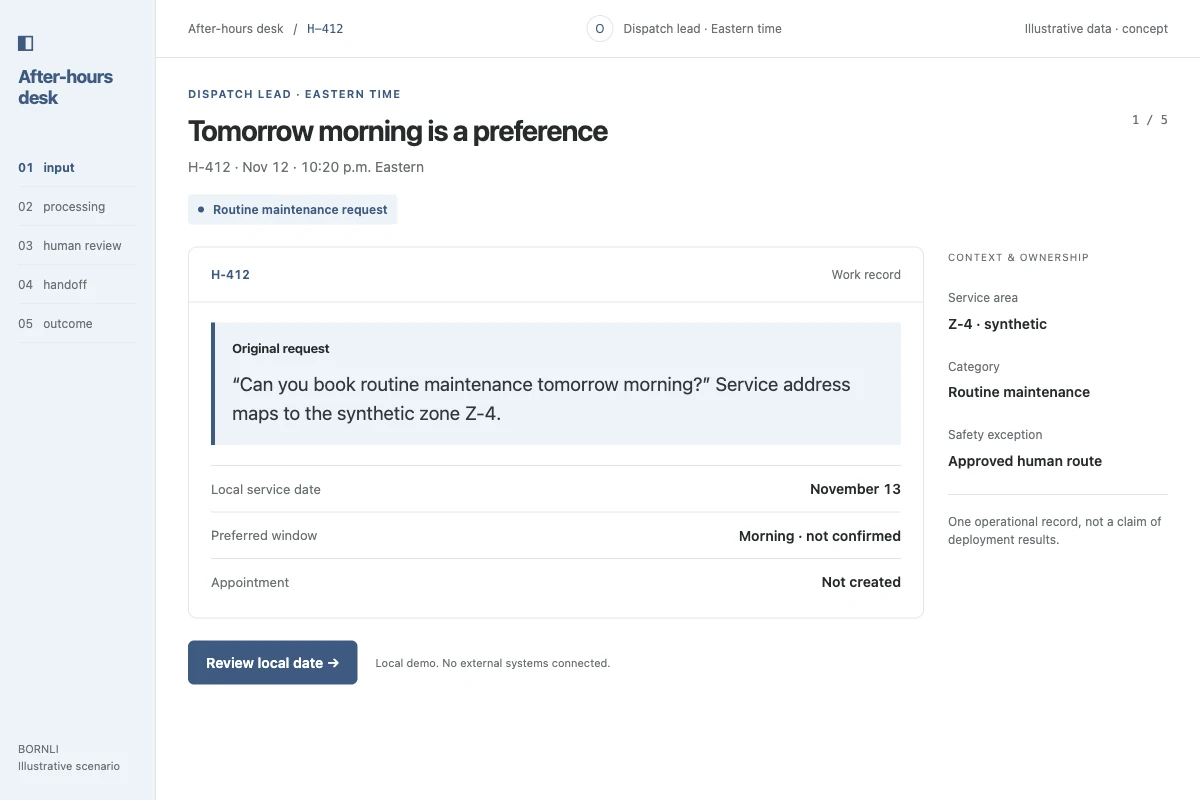
Can the assistant offer the first open calendar cell?
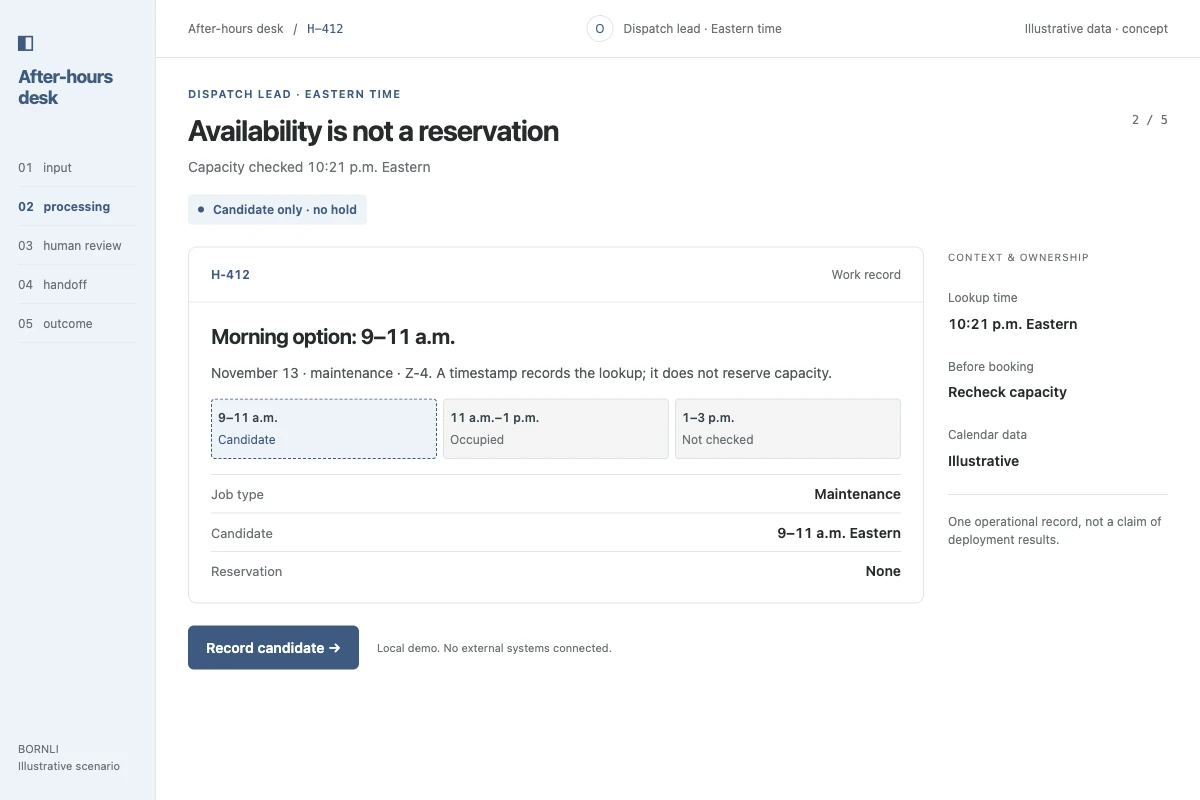
The candidate is November 13, 9–11 a.m. Eastern, for maintenance in Z-4. A capacity lookup at 10:21 p.m. found availability, but no reservation was made. The record explicitly says “candidate only.” A calendar that looks empty may omit skill requirements, travel constraints or reserved capacity.
Agree how long a capacity response may be used, and whether the platform supports holds. A timestamp is not a hold. If the booking platform cannot atomically reserve a slot, the final create request must handle a capacity conflict and return to the caller with a new option. These are acceptance requirements to test, not claims about every scheduling API.
What if the caller pauses before confirming?
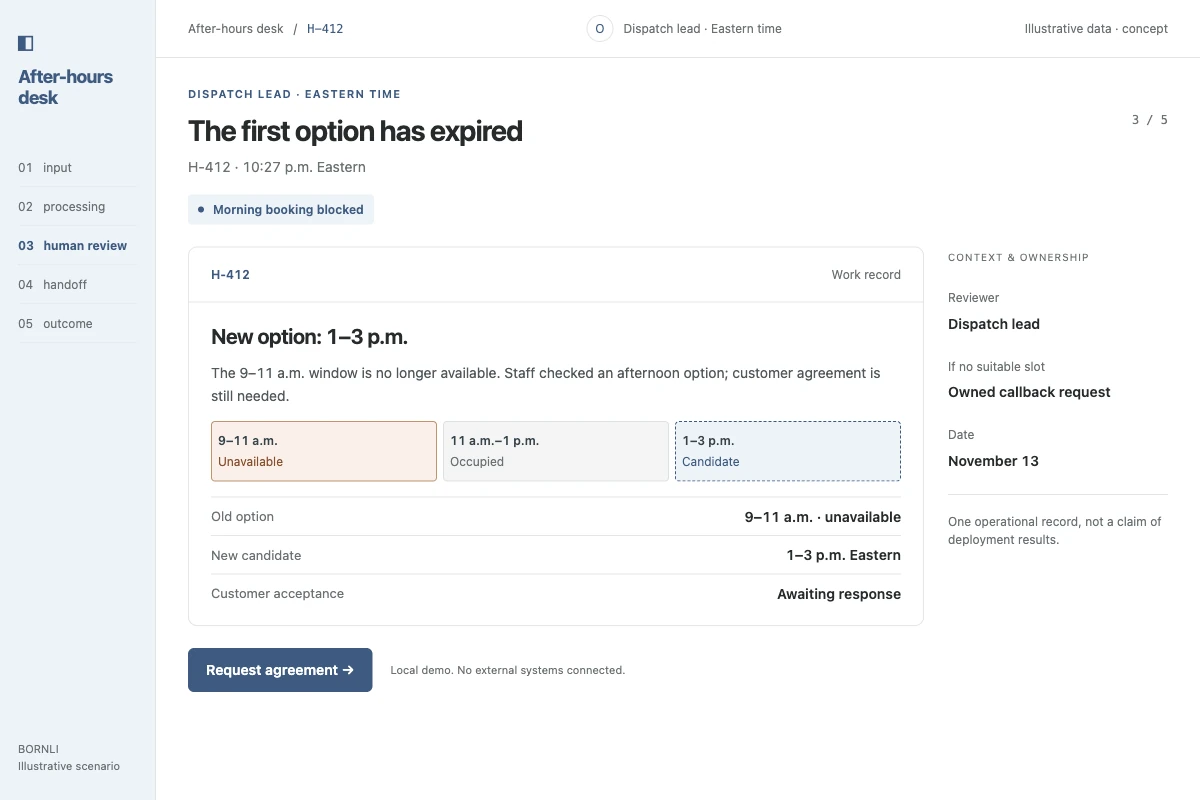
By 10:27 p.m., the concept’s candidate has expired and the morning window is no longer available. Booking remains blocked. A staff reviewer checks a new 1–3 p.m. option and asks whether it works for the customer. Choosing a new window internally does not establish customer agreement.
The model may summarize the exchange, while a structured record captures the customer’s explicit acceptance. If no suitable option remains, create a callback request with an owner and a clear expectation. Do not describe a callback as a booked service visit.
Which response is enough to confirm a booking?
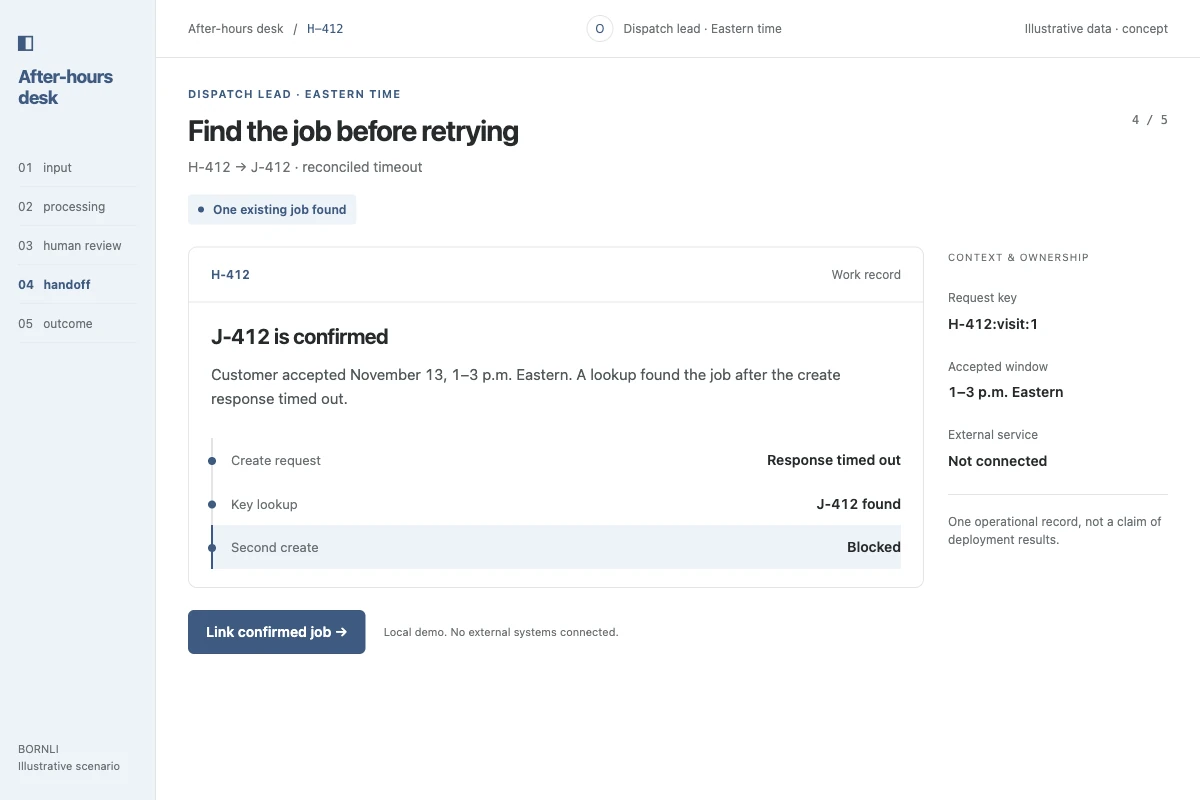
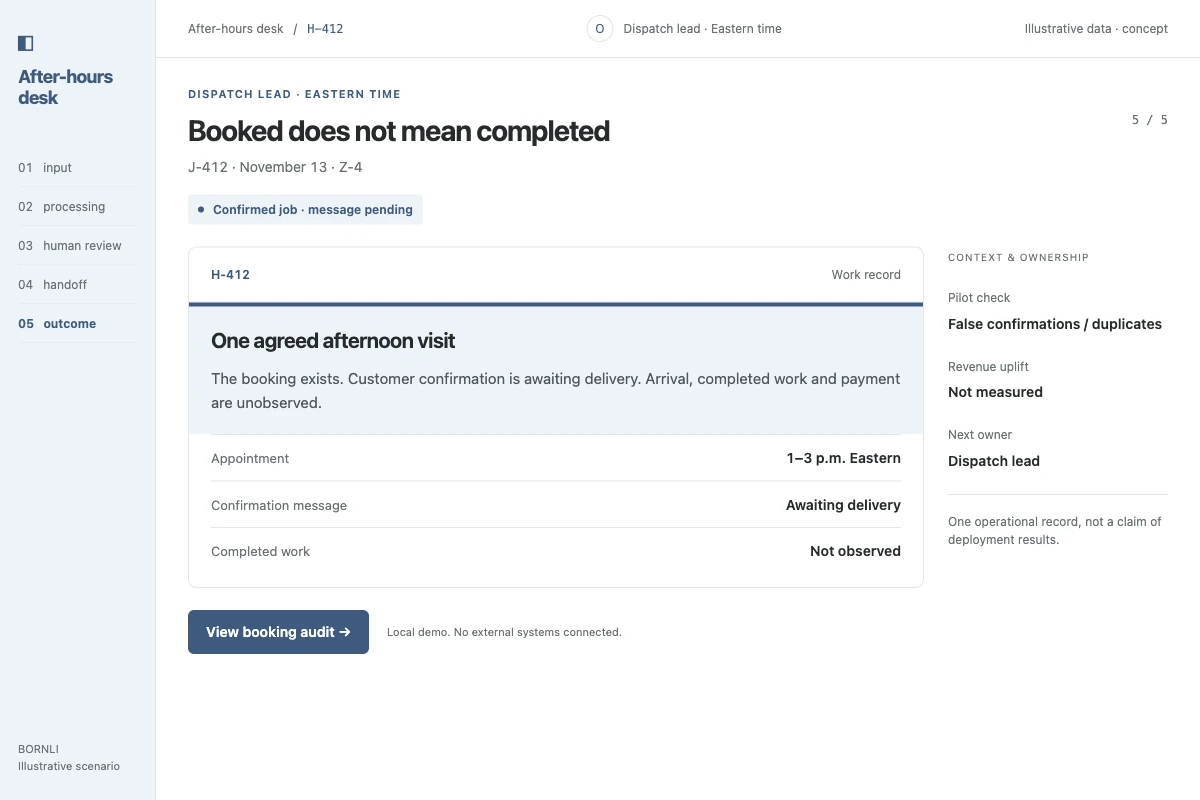
The customer accepts November 13, 1–3 p.m. Eastern. The integration submits H-412 with the agreed job type and address. If the response times out, first look up the booking by the request key. In this concept, that lookup finds job J-412; sending a second create request is blocked.
Only the confirmed job response supports the appointment message. If the platform cannot reliably look up the result, leave the status unresolved for staff. The local demo changes its own screen state and does not call ServiceTitan, send a text or operate a real dispatch board.
How should the pilot be evaluated?
The demo ends with one confirmed job, the agreed afternoon window and a confirmation message awaiting delivery. Technician arrival, completed work and payment are not observed. No revenue or booking uplift is attributed to BORNLI.
Track eligible requests, offers, accepted windows, confirmed jobs and message delivery separately. Review false confirmations, duplicates, expired slots and human handoffs. Compare equivalent periods with the same service area and hours; include capacity-related failures in the report rather than quietly removing them.
A practical pilot uses one location, one job category, redacted examples and a test scheduling environment. Test a midnight date boundary, an out-of-area address, an expired option, an unknown create result and a request for a person. Before launch, name the after-hours escalation owner. Our pilot scope guide covers acceptance decisions; the maintenance guide covers the responsibilities after launch.
Map the workflow before building it.
Tell us what your team handles manually, which tools you use, and where the process gets stuck. Start by email.
Discuss your workflow ↗