BORNLI / product decisions
Urgent guest requests need current context
A late-arrival message can become an access problem. Show the evidence, verify the stay and keep unapproved promises out of the reply.
What should AI handle in a hotel inbox?
AI guest-request prioritization can help hotel operations teams when important messages compete with routine questions. A useful starting point is a review queue that combines the original request with current reservation context. It should suggest urgency and an owner, while staff retain control of access instructions and guest-facing promises.
In its HUSWELL case study, Duve reports a 30% reduction in response times using SmartPriority. The vendor describes priority based on journey stage, topic and sentiment. The measurement period is not disclosed, and this is not an independently audited or BORNLI result. We checked the source on November 11, 2026; its percentage is not a forecast for this concept.
First check whether your existing guest-messaging platform already supports the needed workflow. Custom work is most useful around a specific gap in PMS context, approval or operational handoff, not simply to add another chat window.
What does the agent actually know?
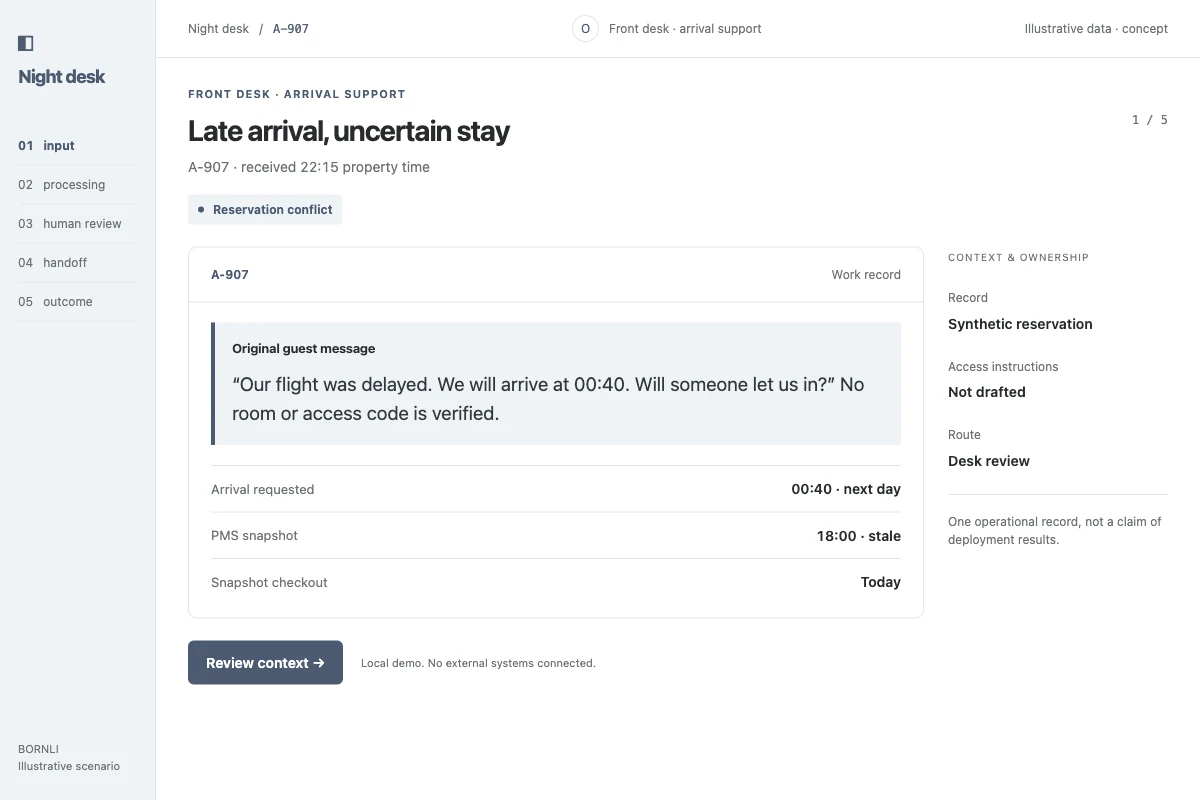
BORNLI illustrative scenario. Request A-907 says: “Our flight was delayed. We will arrive at 00:40. Will someone let us in?” The message arrived at 22:15 property time. The reservation snapshot was last refreshed at 18:00 and shows checkout today. The date conflict is visible before anyone drafts access instructions.
The record does not contain a verified room assignment or a door code. The prototype uses synthetic data and has no PMS connection. A real system would need controlled access to the minimum reservation fields and a clear property timezone, especially when a request crosses midnight.
How should stale context change the route?
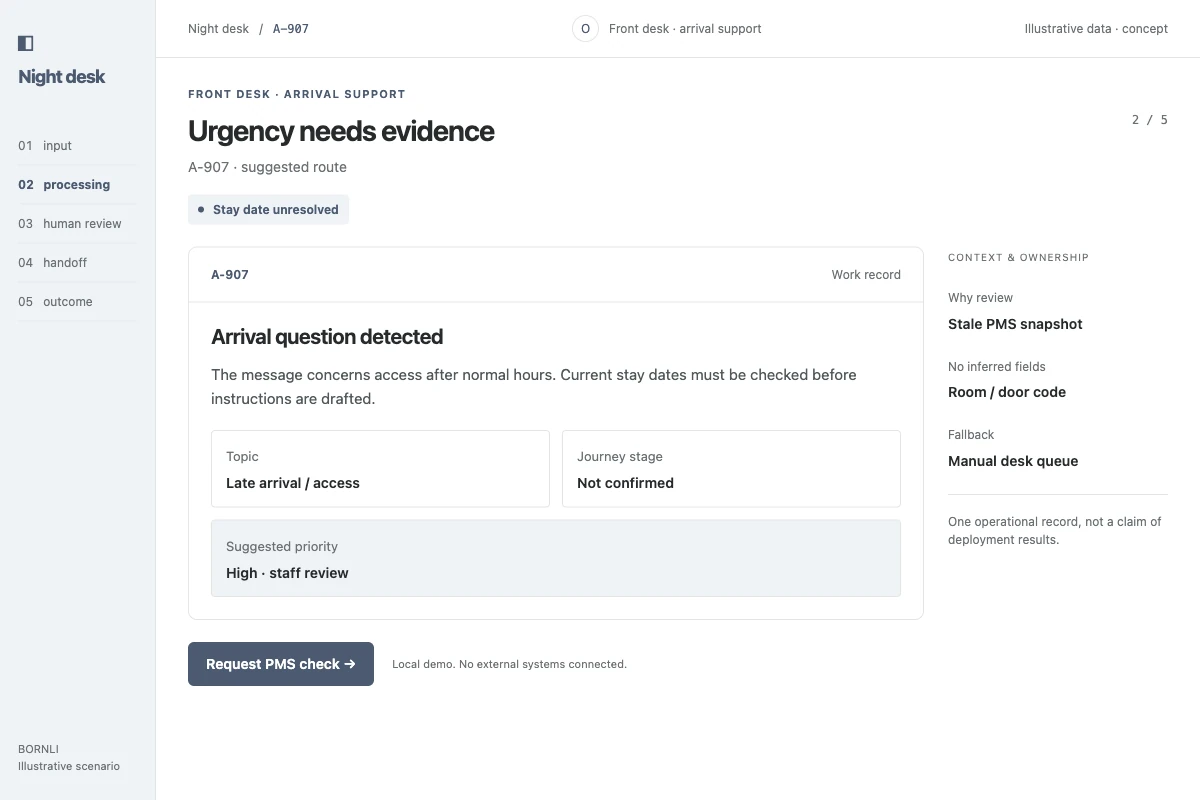
The concept extracts arrival time and the guest’s access question, but marks the stay date as unresolved. A high-priority review is proposed because the request concerns arrival outside normal hours; the exact service priority must follow the property’s policy. No room or access information is inferred from a guest’s tone.
A failed PMS refresh leaves the request in the review queue with its original message intact. It must not turn stale reservation data into a confident answer. A staff member can continue manually if the model or PMS integration is unavailable.
What does the desk agent confirm?
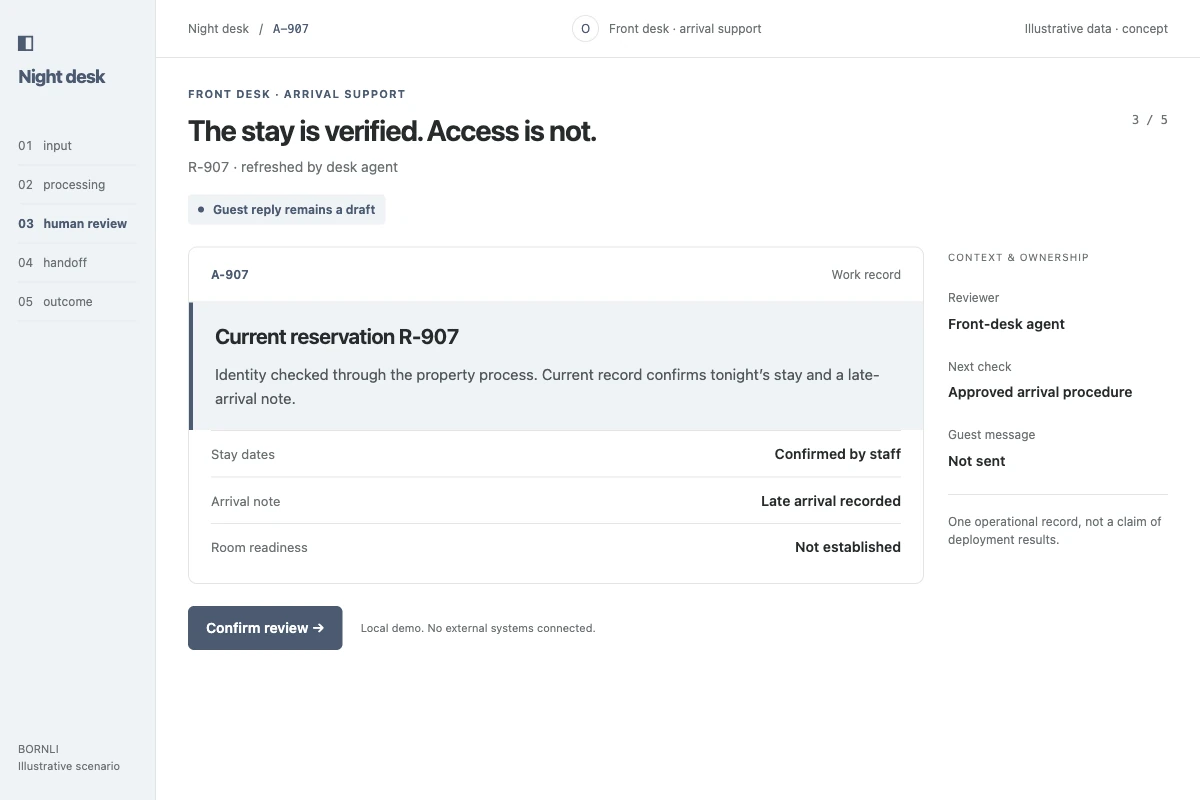
In the next illustrative state, the desk agent refreshes reservation R-907 and checks the guest’s identity through the property’s established process. The current record confirms tonight’s stay and a note about late arrival. This resolves the date conflict; it does not establish that a room is ready or that a particular entrance is open.
The guest-facing response remains a draft. Staff confirm the approved arrival procedure separately. Never place door codes, identity documents or full reservation details in a broad operational inbox simply because the model can summarize them.
How does the night desk receive one actionable task?
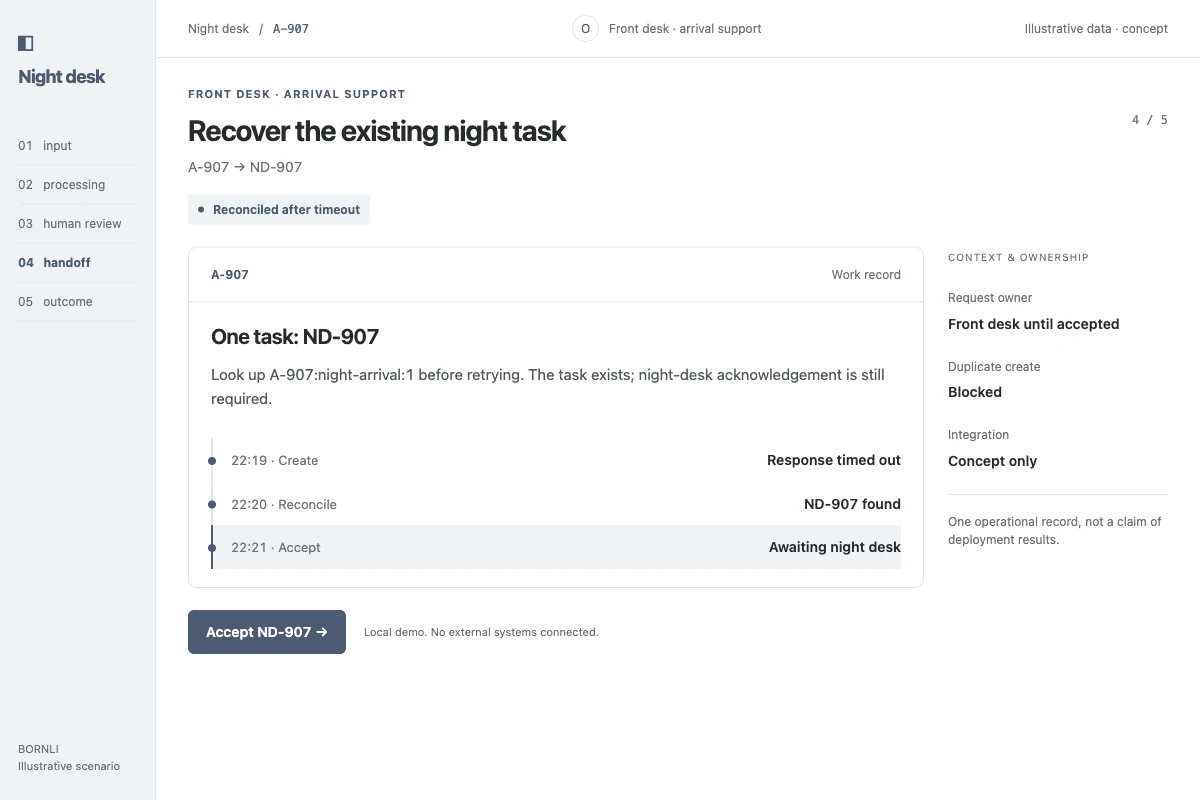
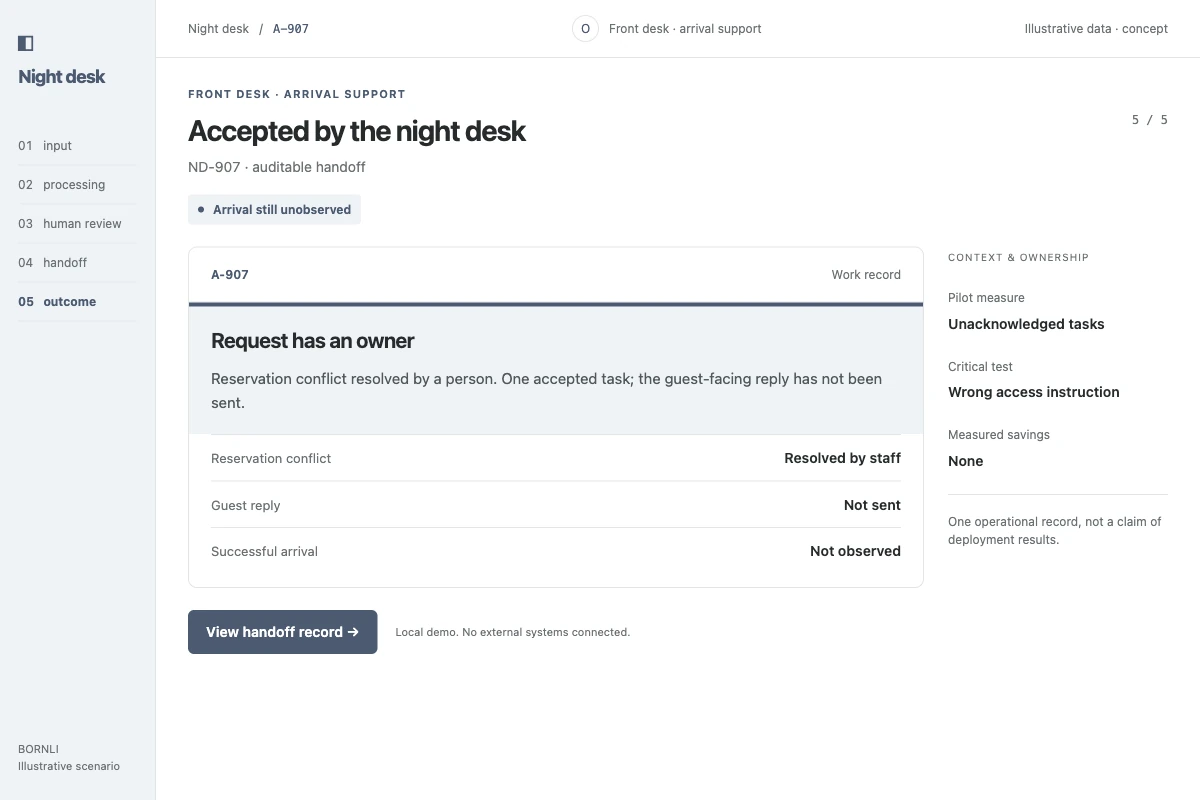
The confirmed request becomes internal task ND-907 for the night desk, linked to A-907 and the verified reservation revision. A timeout after task creation is treated as an unknown delivery result. The system checks the key A-907:night-arrival:1 before retrying; the concept finds ND-907 and keeps one task.
Assignment is not acknowledgement. The night-desk agent explicitly accepts the task. Until then, the front desk remains responsible for following it up. The local prototype changes only its own state; it does not contact a guest or operate a hotel system.
What would count as a useful pilot result?
The concept ends with one accepted night-desk task and a reservation conflict resolved by a person. The guest reply has not been sent, and successful arrival has not been observed. Those boundaries matter: a completed AI classification is not a completed guest service.
Start with late-arrival requests for one property, using redacted examples and one handoff destination. Track staff review time, stale-context detections, unacknowledged tasks and duplicate tasks. Test wrong-property messages, midnight date boundaries and unavailable PMS access. Any unauthorized access instruction is a critical failure, not something to hide inside an average accuracy score.
Bring a sample request, your approval rules and the systems the desk actually uses. See our pilot acceptance guide for deciding when a workflow is ready. We would scope the integration around your process; no project price or measured saving is implied by this demo.
Map the workflow before building it.
Tell us what your team handles manually, which tools you use, and where the process gets stuck. Start by email.
Discuss your workflow ↗