BORNLI / product decisions
AI freight invoice checks with evidence
Turn a freight bill into a traceable comparison with the shipment record. Keep a disputed accessorial visible until an authorized reviewer resolves it.
What is the smallest useful freight pilot?
AI freight invoice checks can connect a bill to its shipment accrual, flag a mismatched charge and assemble evidence for an AP reviewer. Start with one carrier document format and one accessorial rule. A general invoice reader is not enough when the decision depends on what happened on a shipment.
Navia's July 10, 2024 announcement describes its Raft rollout for AP-invoice extraction and validation against existing data. This is Navia's account, not an independent audit or BORNLI implementation. The article gives no dated measurement window or US-only result. We use the process as a reference, not a performance promise.
Which shipment does the bill belong to?
BORNLI illustrative scenario. Freight bill FR-2081 refers to shipment SH-604: $800 linehaul, $80 fuel and $100 liftgate, totaling $980. The shipment accrual is $880. All records, parties and amounts are synthetic; these are not market rates or a customer result.
Preserve the original invoice and its revision. Check carrier identity, shipment reference and currency before comparing amounts. A repeated bill number from another carrier is not automatically a duplicate.
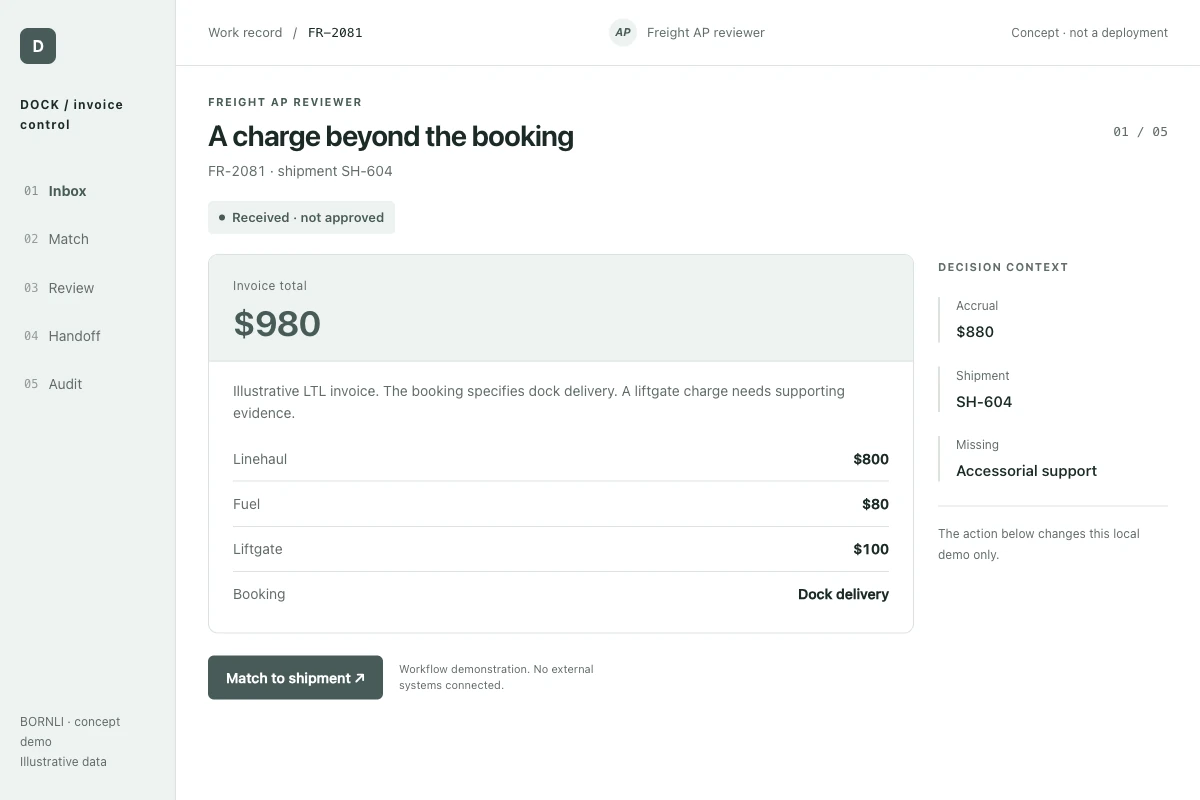
What supports the extra charge?
The linehaul and fuel match the illustrative accrual. The $100 liftgate charge has no matching accrual line, and the booking says dock delivery. That is a review flag, not proof that liftgate service never occurred.
The reviewer needs the booking, applicable rate agreement and delivery evidence beside the flagged line. Use a deterministic comparison for approved rates; use AI to extract and propose mappings. If the contract version is missing, hold the comparison instead of choosing the most convenient rate.
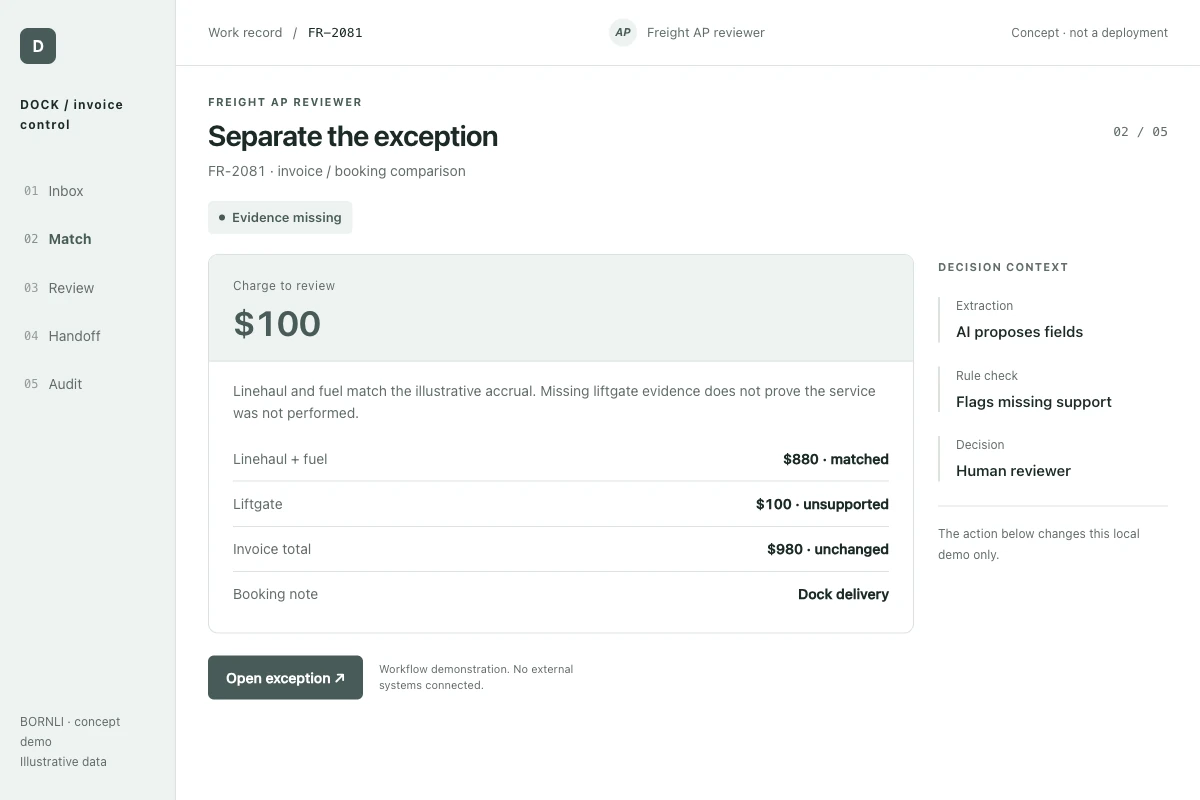
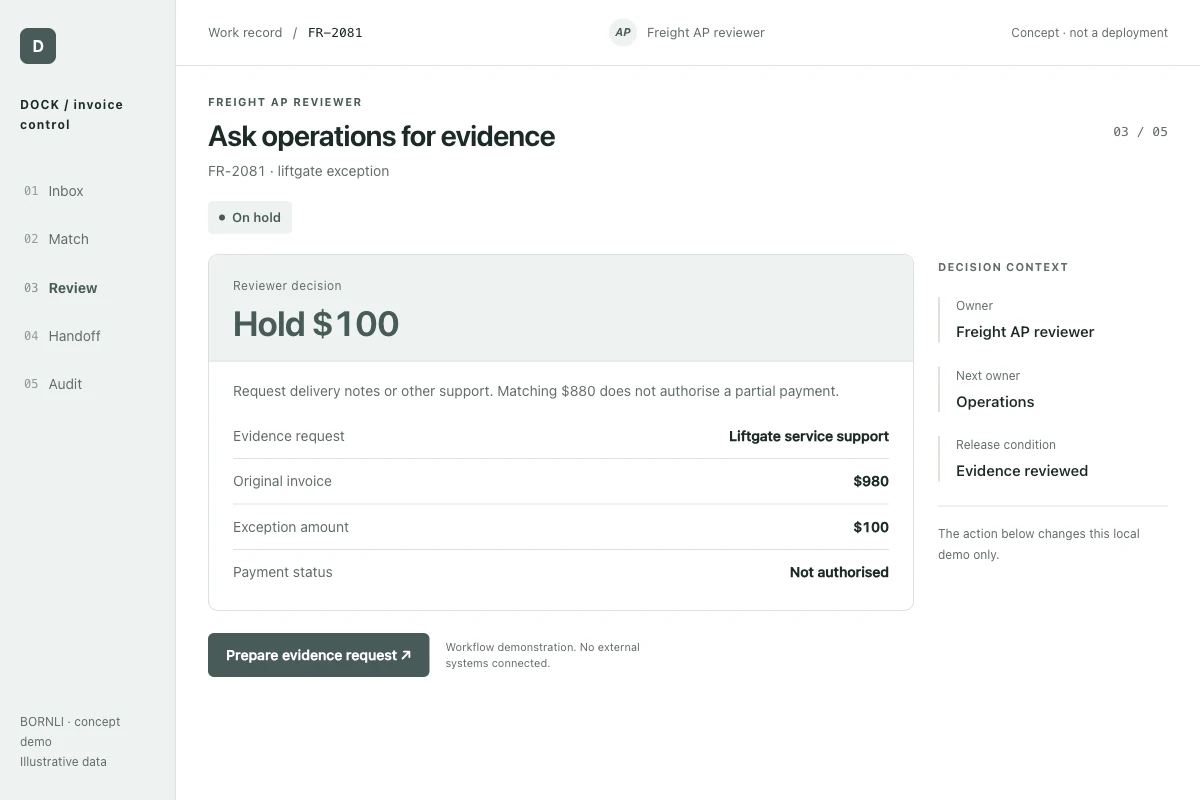
Who owns the disputed accessorial?
The reviewer holds the liftgate line and assigns evidence collection to operations. The original $980 bill stays intact. The $880 matched portion is not automatically approved for payment.
Allow a reviewer to correct a bad extraction or record new supporting evidence. A later carrier revision must reference the original bill and trigger a fresh check. AI must not invent a credit memo or decide whether a contract entitles the carrier to payment.
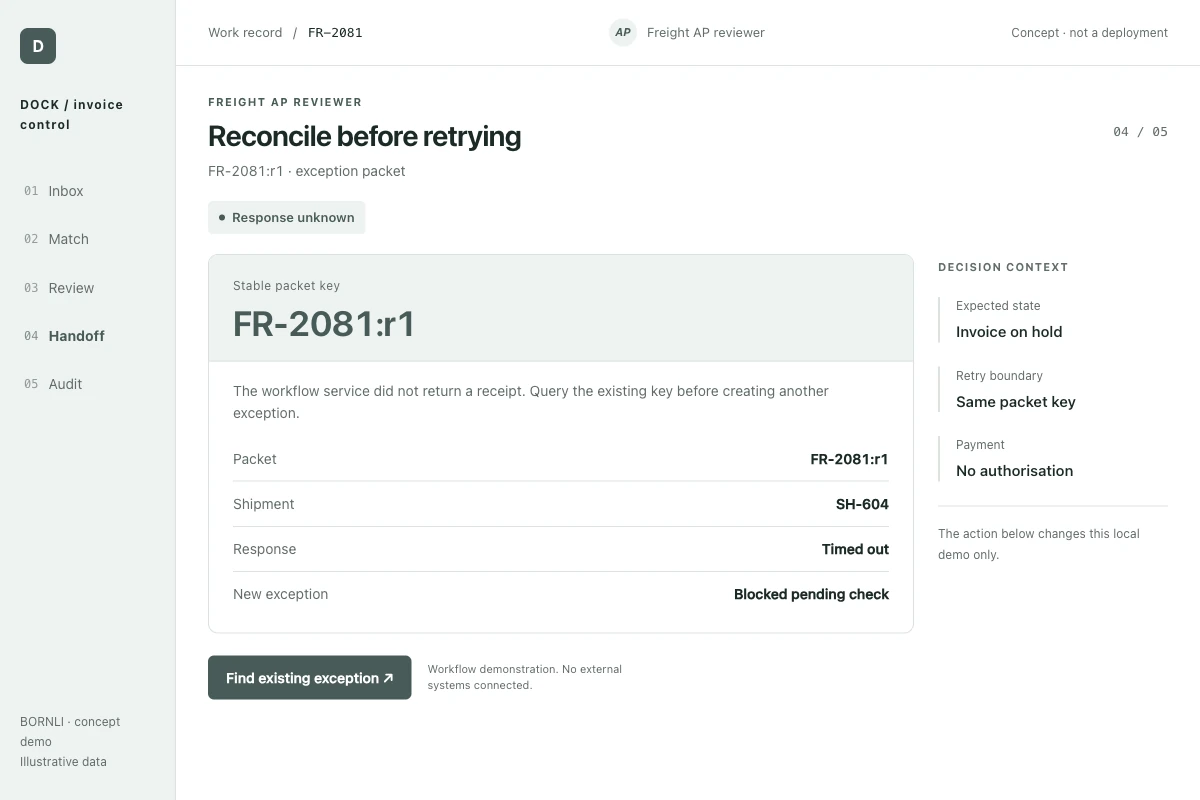
Can the same review be sent twice?
Review packet FR-2081:r1 is approved for handoff, but the simulated ERP response times out. Keep its status “Response unknown.” Reconcile the original operation before issuing another create.
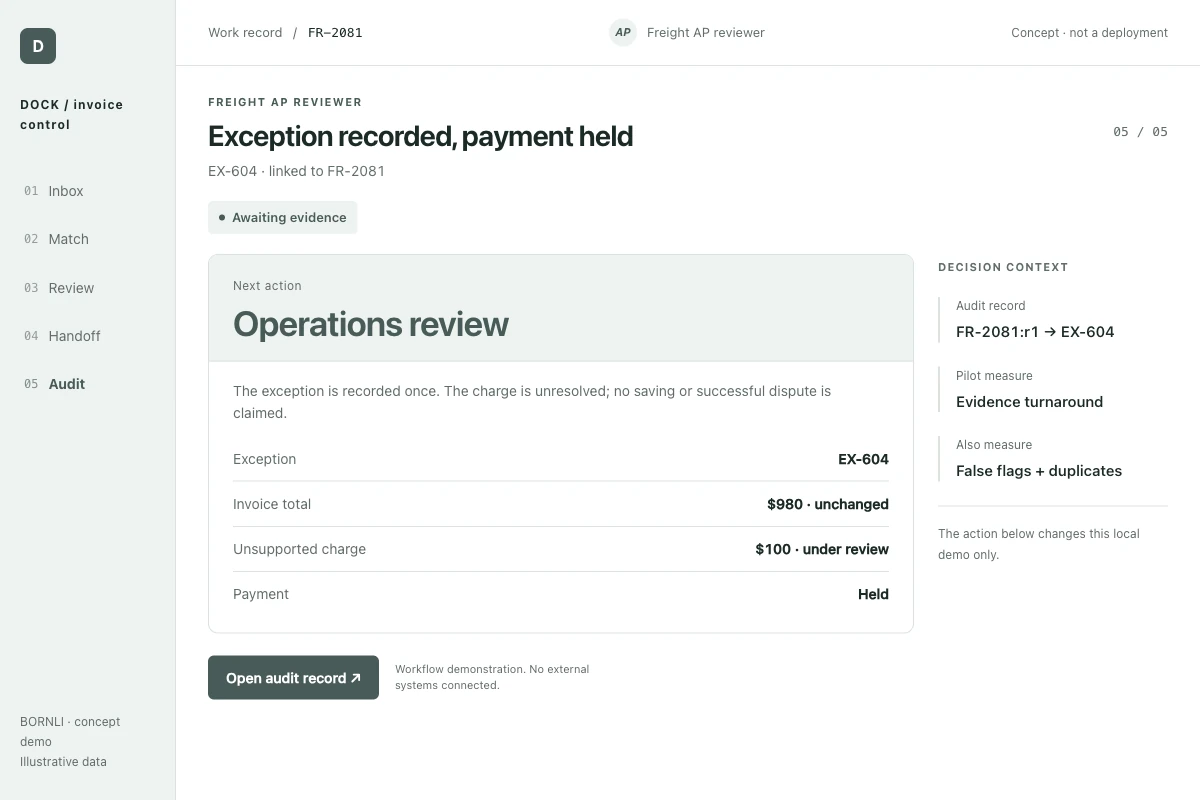
In the concept, reconciliation finds exception EX-604. The demo action displays the existing exception key; it does not create another. A real adapter must implement and test that guarantee with the target system.
What changed, and what did not?
The packet is recorded as EX-604 and assigned to operations. The invoice remains on hold, the liftgate evidence is unresolved, and no payment has been made. That is the outcome of this local concept demo, not a recovered saving.
For a pilot, measure minutes per reviewed bill, mapping corrections, false exceptions, unresolved aging and duplicate handoffs. Compare similar carriers and document mixes. Test a repeated bill, a revised bill, missing proof and an unavailable ERP before widening the scope.
For purchase-order quantity mismatches, use supplier-invoice exception handling. This freight workflow needs a shipment accrual and accessorial evidence. Bring a redacted bill, booking, agreement and one disputed charge to scope the first version.
Map the workflow before building it.
Tell us what your team handles manually, which tools you use, and where the process gets stuck. Start by email.
Discuss your workflow ↗